AI Agents for Dental Practices: What They Do & Cost
AI agents for dental practices answer calls, book and confirm visits, chase recall and no-shows, and check insurance. What works, what it costs, and where to start.
The phone rings at 6:40 on a Tuesday evening. Two calls ring through while the front desk checks in a patient, and the third caller hangs up. That third one was a new patient with a cracked crown.
AI agents for dental practices are software assistants that handle front-desk work. They answer the phone and book patients. They confirm appointments, chase recall and no-shows, and verify insurance. They work with the practice management system you already use, and most are off-the-shelf rather than custom. Clinical AI reads X-rays, and administrative AI runs the desk. Staff stay in charge of both.
A doctor’s office runs the same front-desk pattern, covered in AI agents for medical practices.
Most writing on this topic comes from vendors ranking their own tool first. I run a local SEO agency and I automate my own lead gen. This is the operator’s version: what the agents do, what they cost, and what to check before you pick one.
TL;DR
- Administrative AI runs the phone, confirmations, recall, and no-show follow-up. Most offices start with one of those jobs.
- Clinical AI reads radiographs and drafts chart notes. Dentists hold back from using it for treatment decisions.
- Software plans run $99 to $599 a month per location. A live-agent answering service starts at $300 for 30 calls.
- No vendor touches patient data before a business associate agreement is signed.
What are AI agents for dental practices?
An AI agent for a dental practice is software that finishes a front-desk job end to end. It can book, confirm, remind, and rebook a no-show. It connects to the tools the office already runs and hands off to a human when a decision needs judgment.
The difference that matters: a chatbot answers a question, an agent finishes the job.
A chatbot replies to “what time is my appointment?” An agent checks the schedule, sends the confirmation, and updates the system. That single difference decides what these tools are worth in a dental office.
Dental offices run on standard practice management systems, and the American Dental Association practice resources treat that software as the center of the front desk. The names you will hear most are Dentrix, Eaglesoft, and Open Dental. Agents sit on top of that software instead of replacing it.
AI in a dental office covers 2 groups of work, and they carry different risk.
| Job in the office | Clinical AI | Administrative AI |
|---|---|---|
| Reads radiographs and flags decay | Yes | No |
| Drafts chart notes and perio charting | Yes | No |
| Answers the phone and books patients | No | Yes |
| Confirms visits and chases no-shows | No | Yes |
| Checks insurance and follows up on a claim | No | Yes |
| Who signs off on the output | The dentist | The office manager |
The ADA Health Policy Institute survey data from its quarterly panel of U.S. dentists shows where adoption sits. In the mid-2026 round, 43.3% of responding dentists used AI for at least one task, and 26.4% planned to start.
The split is the interesting part. 22.8% used AI for imaging and diagnostics. On the desk side, 13.6% used it for insurance verification and 10.1% for reception or front desk check-in. Under 5% used it for treatment recommendations.
The staffing numbers explain the rest. 32.4% of dentists report being overworked, and practices keep reporting staffing shortages. The same HPI report ties the rising interest in charting and insurance tools to those shortages and to the hours dentists spend on non-clinical work.
Imaging is the one task above 20% of dentists. The desk layer is where a small office earns a return first.
How do AI agents help dental practices day to day?
Day to day, agents take the jobs that interrupt the front desk. That means booking, confirmations, recall reminders, no-show follow-up, and the patient questions asked every day. Staff keep the calls that need judgment or empathy.
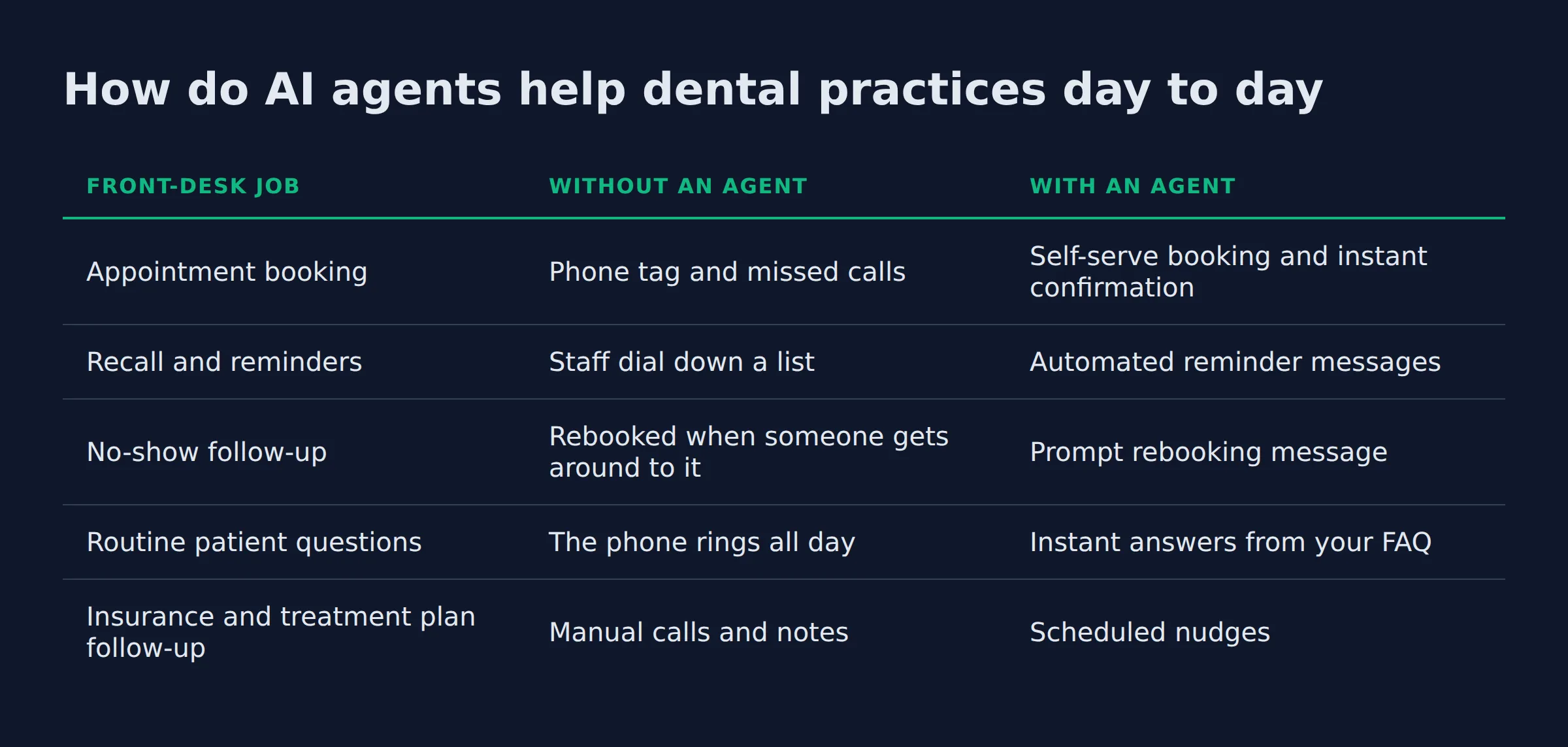
| Front-desk job | Without an agent | With an agent |
|---|---|---|
| Appointment booking | Phone tag and missed calls | Self-serve booking and instant confirmation |
| Recall and reminders | Staff dial down a list | Automated reminder messages |
| No-show follow-up | Rebooked when someone gets around to it | Prompt rebooking message |
| Routine patient questions | The phone rings all day | Instant answers from your FAQ |
| Insurance and treatment plan follow-up | Manual calls and notes | Scheduled nudges |
Dental offices also live and die by lead response time. The Google Business Profile message that sits for a day is a patient who booked elsewhere.
My own outreach system takes in around 200 form submissions a day and answers every one without a person. The first thing that changed my week was putting follow-up on autopilot: confirmations went out in minutes, and the backlog disappeared. A dental front desk runs the same pattern with fewer leads and higher stakes. I have not run a dental front desk. But I have watched booking, follow-up, and recall in enough service businesses to know where the hours go.
Every front-desk job here has the same shape: predictable, repetitive, and started by an interruption.
AutomateReal skills
Can an AI agent answer the phone and book patients?
Yes, for routine calls. A voice agent answers at any hour and books into the practice schedule. It sends confirmations and passes urgent or upset callers to a person. Whether it writes back to the practice management system decides how much staff time it saves.
The tools split into 2 groups. Some are phone systems with an assistant added. Others are dental-only agents that read the schedule the way a trained receptionist does.
| Tool | What it handles | Practice management write back |
|---|---|---|
| CloudTalk | 24/7 answering, emergency triage, CRM sync | Open API, 100+ integrations |
| Arini AI | Dental scheduling logic, recall campaigns | Dentrix, Eaglesoft, Open Dental, Denticon, CareStack, Curve Dental |
| Weave | Calls, texts, payments, reviews, AI receptionist | Major dental systems, confirm write back |
| Dentina AI | Voice plus SMS scheduling | Dentrix, Dentrix Ascend, Open Dental, Eaglesoft, Denticon |
| Smith.ai | AI triage plus live agents | 7,000+ integrations |
| Resonate AI | Missed call text back | Not published |
Most of those rows come from CloudTalk’s tool comparison and Arini’s own site, and Dentina’s write-back list is on its pricing page.
The write-back list matters more than the feature list. An agent that cannot see the schedule is an answering machine with a subscription.
CloudTalk’s comparison also carries the numbers that drive the decision. Up to 30% of dental calls go unanswered during business hours, and each recovered new-patient call is worth $850 to $1,300 in first-year revenue.
My test for a phone agent is boring. I put it on one real job for a week, then read the transcript of every call it handed to a person. If the handoffs are clumsy, the rest of the demo does not matter.
Sign off on 2 rules before the agent answers a patient. It should say it is an AI when someone asks. It should ask before recording a call.
Ask a vendor for one recording of the agent on a real new-patient call. A demo line is theater.
Which front desk jobs should a dental office hand to AI first?
Start with missed call text back, then confirmation messages, then recall. Those jobs need no clinical judgment, and they run on data the office already has. The payoff shows up in the first month.
The test I use to pick the first job
A job is ready for an agent when it passes 3 checks:
- It repeats daily.
- It follows a rule you can write on one line.
- It shows up in a number you already track.
Missed call text back passes all 3 checks. It happens every day, the rule is short, and the number is calls answered.
Confirmations pass the same test, and the research behind them is stronger than most owners expect. A systematic review of machine learning no-show models in the International Dental Journal puts the average share of unattended appointments at 23%. The 4 dental studies it reviewed saw no-show rates from 13.5% to 48%.
That review names its top predictors without ranking them. Across the studies it covered, the most important ones were SMS confirmation status, prior no-show history, and appointment timing. Patients who did not confirm by text were more likely to miss the visit.
| Order | Job | What it removes from the day | Proof you can count in week one |
|---|---|---|---|
| 1 | After-hours and missed calls | Callers who hang up and book elsewhere | Calls answered after 5pm that become appointments |
| 2 | Appointment confirmations and reminders | Manual reminder calls and late cancellations | Confirmed visits per day |
| 3 | Recall and hygiene reactivation | A recall list nobody has time to work | Reactivated patients per week |
| 4 | No-show follow-up | Empty chairs and idle staff hours | No-shows per week |
| 5 | Insurance verification and intake | Time on hold and re-keying at check-in | Minutes per patient at the desk |
Recall takes longer to pay off. It is worth doing because the list already sits in the practice management system. Insurance verification goes last, since it needs deep access to that system and the errors cost more.
The return math gets simple once the first row runs. Count the calls that went to voicemail 2 weeks ago and are appointments now. Multiply that by your average value per booked patient. That is your week-one result.
SMS confirmation is one of the strongest no-show signals, and the confirmation text is the cheapest job on this list.
Which AI agents are best for dental practices?
The best AI agents for a dental practice connect to the practice management system you already run and keep a human in the loop. Run 3 checks before you pick one.
- Patient data. Any tool that touches patient data is bound by the HIPAA Security Rule. Ask the vendor how data is stored and who can see it.
- Your software. Does the agent write back to
Dentrix,Eaglesoft, orOpen Dental? An agent that forces you to export and re-enter data is not saving time. - The claims. The FTC guidance on AI claims warns businesses against overstating what their AI does. A vendor who promises a fully automated front desk is describing their marketing, not their product.
The roundups name the field by layer:
| Layer | Tools the roundups name | Where to check them before you buy |
|---|---|---|
| Clinical imaging and diagnostics | Overjet, VideaHealth, Denti.AI, Pearl, DentalMonitoring, SoftSmile Vision, Denota.ai, PreVu Dental | The FDA device list, then the ADA standard for validation data |
| Phone and reception | Arini AI, Weave, NexHealth, Resonate AI, TrueLark, Dentina AI, Smith.ai, Rondah AI, Adit, CloudTalk | The vendor’s own pricing page, then a live booking test |
| Practice management and patient communication | Dentrix, Dentrix Core, Dentrix Ascend, Eaglesoft, Open Dental, Denticon, CareStack, HeyGent | Your practice management system’s support desk, since write-back starts there |
Those names come from SoftSmile’s roundup and CloudTalk’s comparison. General platforms like Zapier AI agents and Make wire into the same software across 9,000+ apps, so a dental-branded tool has to earn its price.
Run the vendor like you would a new hire: patient data, your software, and proof of their claims.
Does AI dental imaging software replace the dentist?
No. Imaging AI flags areas on a radiograph and hands the image to the dentist, who still reads it and decides. The ADA survey data shows why dentists stay cautious. 82.6% of them say they do not plan to use AI for treatment recommendations.
Clinical tools are regulated, and that gives an owner a real filter. The FDA publishes the FDA’s AI-enabled device list, and it names every AI device authorized for marketing. The dental entries carry clearance dates.
| Tool | Company | Cleared |
|---|---|---|
| Second Opinion Panoramic | Pearl | 11/14/2025 |
| CBCT Assist | Overjet | 12/05/2025 |
| DS Core Detect | Dentsply Sirona | 01/07/2026 |
| Velmeni for Dentists (V4D) Endo-Perio | Velmeni | 05/11/2026 |
A clearance covers the software’s intended use. It says nothing about your patient, your sensor, or your technique.
The ADA standards for AI in dentistry name ANSI/ADA Standard No. 1110-1:2025 as the first U.S. standard on AI in dentistry. It sets the rules for annotating and collecting data from 2D radiographs.
Accountability stays with the dentist. Robert Faiella, D.M.D., chairs the ADA Standards Working Group 12.7. He describes standards as providing “a roadmap for evaluating and integrating AI systems into dental practice,” per ADA guidance on responsible AI use.
One dentist in the HPI panel was blunt about accuracy. “X-rays still need to be reviewed without it anyway, as it makes mistakes,” that respondent said.
A cleared imaging tool adds a second look, and the dentist still signs the chart.
How much do AI agents cost for a dental practice?
Published prices run from $99 a month for a small phone plan to $599 a month for a clinical suite with an AI receptionist. Most one or two dentist offices land near the low end. Minute allowances and install caps move the bill more than the headline price.
| Tool | Published price | What drives the bill |
|---|---|---|
| CloudTalk AI receptionist | From $99 a month, 200 minutes included | Minutes past the plan. The next tier is $349 a month with 1,000 minutes |
| Dentina AI inbound | $299 a month, 30-day free trial, no setup fee | Plan tier and seat count. Outbound campaigns are quote only |
| Denti.AI OneStop Clinical | $399 a month, or $333 a month billed yearly | Installs, capped at 7 on one location |
| Denti.AI OneStop Clinical plus AI receptionist | $599 a month, or $499 a month billed yearly | Unlimited installs, with a fair use cap on the receptionist |
| Smith.ai | $300 a month for 30 calls, then $11.50 a call | Call volume. Live agents answer these calls |
| Arini AI | Not published | Demo only |
Every price in that table came off the vendor’s own page on the day of writing. Roundup prices drift, so treat them as a lead and check the vendor page.
Compare that with staff. CloudTalk’s comparison puts a full-time dental receptionist at $45,000 to $65,000 a year, covering salary, benefits, and overhead. The job stops at 40 hours a week. Software at $99 a month answers at 3am on a holiday.
The bill that surprises owners is usually the meter. Watch the minute counts and the per-location fees, and ask what happens on month 13 when a promo ends.
I test software before I pay for it. Run the free tier or trial for a week against your actual recall list and your actual FAQ. If it cannot handle your real front desk, the subscription price does not matter.
Budget $99 to $599 a month per location and a few hours of staff time. Ignore any quote that hides the minute count.
Do dental practices need custom AI agents, or do off-the-shelf ones cover the front desk?
A typical front desk does not need custom AI agents. Off-the-shelf covers booking, recall, and patient questions, and a custom build adds cost without new capability. Custom earns its keep only for unusual workflows, like a specialty intake or a practice management system few vendors have connected.
The test for custom is boring. List the jobs an agent would do. If most of them are booking, reminders, and questions, off-the-shelf wins. If your practice runs a workflow no other office has, that one job is where custom earns its keep.
The first month is setup. Your hours, your FAQ, and your recall list all have to go in first. The insurance script is the slowest part to get right. If you want someone else to wire it up, the AI services page lists what a done-for-you setup includes. If you want to build these agents yourself, the skills bundle has all skills for $99.
AutomateReal services
Buy off the shelf first, then spend the custom budget on the one job that still fails after 30 days.
The compliance step the listicles skip
Any vendor that touches patient data needs a business associate agreement before it sees a single record. A business associate is a company that needs access to your patients’ protected health information to do a task for your practice, per the ADA guidance for dental practices.
Under the HITECH Act, business associates face the same civil and criminal penalties as the practice for a HIPAA violation. Some terms in the agreement are required by law. Others, including indemnification and insurance provisions, are negotiable. A breach of unsecured PHI must reach the practice within 60 days.
Two duties land back on the office. If a vendor misuses patient data, the practice has to act and, when it cannot fix the problem, end the relationship. When the agreement ends, the vendor must return or destroy the PHI and keep no copies.
The HIPAA rules for dental practices page from the ADA also carries a guide on consent for calls and texts, which is the rule that covers a machine answering your phone. Ask how long the vendor keeps call recordings and transcripts, and get that retention window in writing.
No signed business associate agreement, no patient data. That one document is the compliance test.
Related: AI agents for restaurants
Related: AI agents for ecommerce stores
Related: claude skills for small business
Related: AI marketing agent
Related: AI agents for home service business
Related: AI agents for marketing agencies
Related: agentic AI
Related: generative AI
Related: lindy AI
Related: AI automation
Related: AI virtual assistant
Related: AI agents examples
Related: automation services
Related: how to build an AI agent
Related: agent sdk
Related: open AI agent builder
Related: AI business ideas 2026
Related: top AI agents
Related: what is automation
FAQ
How do AI agents integrate with existing dental practice software?
Through the practice management system you already run. Some agents connect natively to Dentrix, Eaglesoft, and Open Dental, and others reach it through an open API or an automation platform like Make or Zapier. Ask for the write back list in writing, because reading a schedule and updating one are different jobs.
Will AI agents replace dental office staff?
No. Agents take the repetitive calls and messages, and they pass a patient to a person when the situation needs one. The jobs they remove are the interruptions that push the desk behind, and the practice keeps the work that needs judgment.
Can AI agents handle patient data securely and stay HIPAA compliant?
They can, with the right setup. A business associate agreement is the compliance step, and any vendor that sees protected health information signs one first. Some terms are required by law and others are negotiable, so a lawyer should read it before the practice signs.
What should a dental office automate first?
Missed call text back. It needs no clinical judgment, and it runs on the phone number you already own. Confirmation messages are the next job, then recall.
Does AI dental imaging software replace the dentist?
No. Imaging AI flags areas on a radiograph, and the dentist still reads the image and signs the chart.
Watch one week of front-desk work and you will see the jobs an agent can take. If you want help mapping your first workflow, a free discovery call walks through it in about thirty minutes.