Top AI Agents in 2026: What They Do and What They Cost
A ranked, plain-English look at the top AI agents in 2026: what each one does, what it costs, which are free, and how to pick the one to run first.
Search this keyword and you land on a catalog of 15 tools with affiliate links and a price table that went stale months ago. Almost every name on it is a support chatbot. I run agents on my own business, and I am the one who fixes them. Below is the list judged after week one, when something breaks and nobody owns the fix.
Top AI agents are the ones that finish a whole job. Booking, answering, chasing, publishing: the agent owns the sequence and the follow-up. They cluster in four areas, and vendors now price them per finished task rather than per login. Start with your most expensive workflow.
TL;DR
- Four job areas cover most of what is for sale: support and reception, sales outreach, marketing content, and back-office operations.
- Support is the most mature area and the most crowded. The table below prices five of those agents from the vendors’ own pages.
- Prices in September 2026 run from a free plan at Tidio to $0.99 per resolved conversation at Intercom. The top Intercom seat costs $132 each month billed annually, or $139 billed monthly.
- Free tiers are real but thin. Setup and upkeep are the costs the sticker hides.
- Two numbers decide fit: how often the task repeats, and what a wrong answer costs you.
What are the top AI agents in 2026?
The top AI agents in 2026 are grouped by the job they own. Intercom Fin, Tidio Lyro, Freshdesk’s Freddy AI and Hiver run support. Lindy runs multi-step workflows across your apps. The Claude Agent SDK is the live build path. OpenAI’s Agent Builder shuts down November 30, 2026.
One thing before the list. A support agent and a marketing agent are not interchangeable, even when a vendor calls both of them AI agents. Name the job first, then pick the tool that already does that job.
Customer support and reception
Support agents are where the money sits, because one resolved ticket is a billable unit. These agents read a ticket, answer from your own help docs, and pass the strange cases to a person.
Hiver puts its support agent inside the Growth plan at $25 per user each month on annual billing, per its pricing page. A voice seat adds $30 each month and extra minutes run $0.03.
Intercom bills Fin at $0.99 per outcome and lets you run it on top of the helpdesk you already pay for, with no seats required. Tidio keeps a $0 plan and sells Lyro AI from $32.50 each month for 50 AI conversations, on its pricing page.
Sales outreach and follow-up
Outreach agents write the first email, send the follow-up on day three, and stop the moment a reply arrives. This is the job most owners should automate first, because a forgotten follow-up is a lost job that never shows up on any report.
Marketing content
Content agents brief, draft, check and publish on a schedule. The ones worth paying for run the whole line, from research through publishing to a note on how the page performed.
Internal operations and back office
Back-office agents move data between systems: invoices, estimates, CRM notes and reports. They are the least exciting agents on this page and the fastest to pay off, because the work is identical every single time.
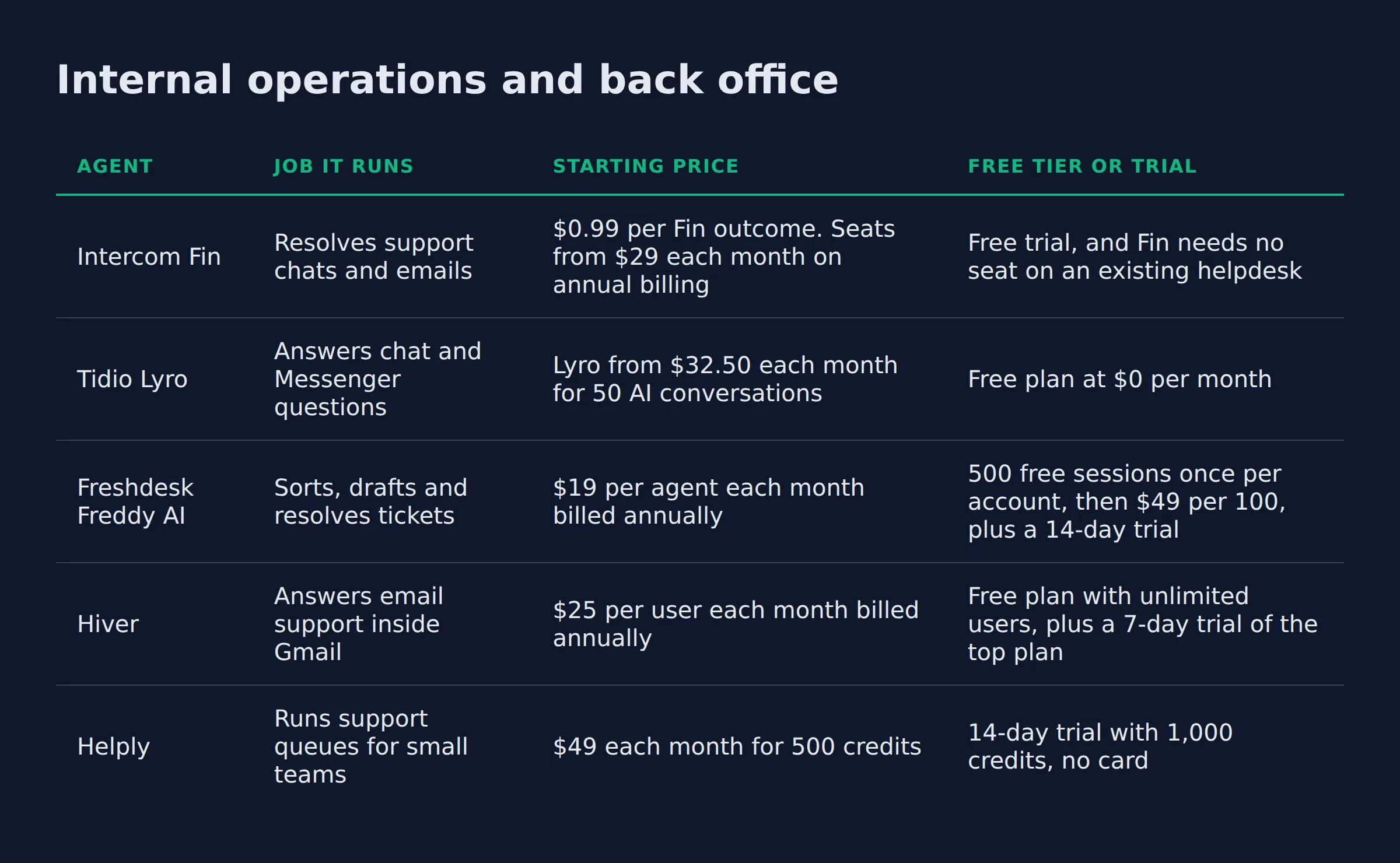
The five agents named most often in this category all run support, which tells you where the market went first. Prices below come from each vendor’s own pricing page, read in September 2026. Check them again the week you buy.
| Agent | Job it runs | Starting price | Free tier or trial |
|---|---|---|---|
| Intercom Fin | Resolves support chats and emails | $0.99 per Fin outcome. Seats from $29 each month on annual billing | Free trial, and Fin needs no seat on an existing helpdesk |
| Tidio Lyro | Answers chat and Messenger questions | Lyro from $32.50 each month for 50 AI conversations | Free plan at $0 per month |
| Freshdesk Freddy AI | Sorts, drafts and resolves tickets | $19 per agent each month billed annually | 500 free sessions once per account, then $49 per 100, plus a 14-day trial |
| Hiver | Answers email support inside Gmail | $25 per user each month billed annually | Free plan with unlimited users, plus a 7-day trial of the top plan |
| Helply | Runs support queues for small teams | $49 each month for 500 credits | 14-day trial with 1,000 credits, no card |
None of these agents replaces the queue owner. Each one needs a written rule for when the conversation goes to a person, and that rule is the first thing to write down. The rule also decides your price. Intercom counts an outcome as a resolved conversation, while Freshdesk gives 500 free sessions once per account before the meter starts at $49 per 100.
The job comes before the tool. A support agent cannot chase your quotes.
Where the list you found online breaks down
The roundup that ranks for this phrase aims at small B2B SaaS support teams. Its price table disagrees with the vendors it names.
Its at-a-glance table lists Intercom at $39 per seat and Freshdesk at $15 per agent, against the vendors’ own numbers. Intercom’s page today shows $29 per seat for Essential on the annual view, and $39 on the monthly list. Freshworks bills $19 per agent for Growth. Part of that gap is the billing period the table used, and the rest is age.
Three gaps matter more than the price drift. That page has no local, trades or home-service use case, and no path for buying a build instead of a tool. It also skips the question owners ask first, which is where to start.
A roundup written for support teams will not map onto a trade business.
The same uncertainty shows up on Reddit, where a developer asked r/Entrepreneurs whether the demand for agents is even real. The answers split between consultants who see demand and owners who want one repetitive task gone. Read them for failure modes. Nobody in them runs your workflow.
Which AI agent is best for a small business?
There is no single best agent, and any list that names one is guessing about your week. The best agent for a small business is the one pointed at your most expensive repetitive task. It is priced per finished task, and it is still running long after launch day.
Adoption is still low, and the survey numbers only make sense once you check what each one measures.
| Source | What it actually counts | The number |
|---|---|---|
| Census Bureau BTOS data | AI use in business operations, two-week window | 17% to 20% of firms from December 2025 to May 2026, and 37% of firms with 250 or more staff |
| SBA Office of Advocacy research spotlight | Firms under 250 employees using AI in operations | 8.8% of small firms against 11.1% of large firms, up from about 6.3% six months earlier |
| U.S. Chamber of Commerce report | Any AI use, including simple tasks | Close to 60% of small businesses, and 84% of high-tech adopters reporting gains in sales and profits |
The Chamber figure counts any AI use at all, including drafting an email. The Census figure covers AI used in operations. Do not average the two.
The two headline numbers count different things, so the gap between them is not a contradiction.
For a narrower shortlist of the best AI agents for small business, read AI agents for small business.
Which AI agents are best for business automation?
The best AI agents for business automation are the ones that already touch your systems. Lindy runs multi-step tasks across the apps you connect. OpenAI’s Agent Builder shuts down November 30, 2026. The Claude Agent SDK suits a developer who owns the code and the upkeep.
There are three ways to get an agent running, and they differ in one place that matters. Who fixes it when an app changes.
| Path | What you pay for | Who owns the upkeep |
|---|---|---|
| No-code builder | A monthly seat and a credit allowance | You do, and it breaks quietly |
| Platform agent builder | Usage inside a platform you already pay for | The platform, within its own walls |
| Code SDK or managed build | A developer or a partner, then a support line | The build owner, on a schedule |
I keep a lead-gen pipeline of my own running at around 200 form submissions a day, and the failures are never clever. An expired key, a form field that got renamed, a contact that landed in the CRM twice. Anyone selling you agents that look after themselves has not run one for a full quarter.
Lindy’s plans start at $29.99 per user each month, per its pricing page. Our notes on Lindy AI cover that path. The Agent Builder shutdown is worth reading before you pick a build tool. The Claude Agent SDK is the option when you want the workflow in your own repo.
The path you pick decides who is on the hook at 9pm when an app changes.
What are the best AI agents for marketing?
The best AI agents for marketing own the steps that repeat. Drafting is cheap now. The value sits in repurposing the draft, scheduling it, chasing the review request, and reporting what landed.
I run an SEO pipeline built from a small team of agents. One researches, one plans, one drafts, one reviews, and one publishes. This post is its output, which is either a fair warning or a decent demo.
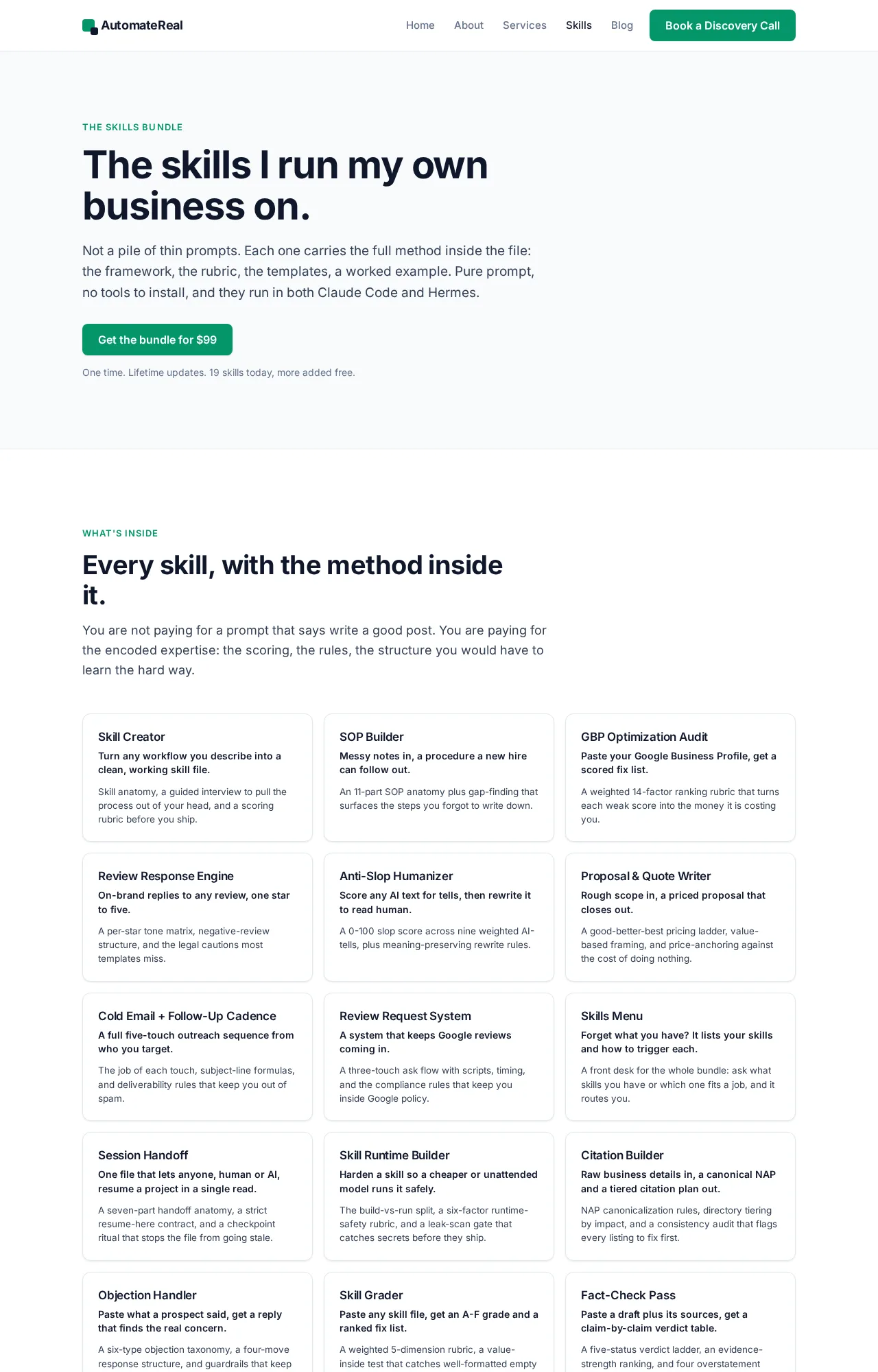
The pipeline holds together because the prompt skills behind it are written down and reused. I sell those skills at automatereal.com/skills, all of them for $99. They cover marketing, SEO and copywriting work.
The written process decides whether an agent’s output is publishable. The tool does not.
That is the honest pattern for marketing agents. The tool is the easy purchase, while the written process is the part you cannot buy off a shelf. For more agent work in the wild, see real AI agent examples.
AutomateReal skills
How much does an AI agent cost per month?
Support agents run from $0 to $132 per seat each month on Intercom’s Expert tier billed annually, and most vendors charge for finished work on top of that. The number that matters is cost per finished task, set against what that task costs you in hours today.
Four pricing models show up across the pages I read in September 2026. Each one hides its cost somewhere different.
| Pricing model | What it counts | Example from a vendor page | Where the cost hides |
|---|---|---|---|
| Per seat | People with a login | Intercom Essential, $29 per seat each month on annual billing | You pay for seats while the agent does the work |
| Per outcome | A resolved conversation | Intercom, $0.99 per outcome | A minimum monthly commitment applies |
| Per session block | AI sessions past the free ones | Freshdesk, 500 free once per account, then $49 per 100 | A busy month costs more than the plan you chose |
| Per credit block | Units of AI work | Helply, 7,000 credits for $399 on Starter | Low, medium and high actions burn credits at different rates |
The sticker price is the small number. The hours to set the agent up correctly and the hours to keep it running are the real invoice, and no pricing page lists them. Judge an agent against the task you stop doing. The tool beside it will not tell you that.
Nobody sells you the two hours a week of upkeep. Budget for them anyway.
Can I get an AI agent for free, or build one without code?
Free AI agents for small business are real in 2026, and a no-code builder lets you wire one without writing code. Free buys the software and the first test. Everything after that is your time or a paid plan. If you want to build a business on top of these tools, start with AI business ideas for 2026.
- Tidio keeps a free plan at $0 each month, per its pricing page.
- Hiver runs a free plan with unlimited users, and a 7-day trial of its top plan, per its signup page.
- Freshdesk gives 500 free AI sessions once per account, then charges $49 per 100, per Freshworks.
- Helply gives 14 days and 1,000 credits with no card, per its pricing page.
- Lindy’s free week goes to teammates who join through Slack. Direct signups are billed at once, per its pricing page.
Those free plans and trials are enough to prove one workflow on real volume. Choose the trial by the job you want finished, not by the longest free window.
Building AI agents for small business is an option now too. Lindy skips the code, and the agent builder walkthrough covers the shutdown date on OpenAI’s Agent Builder and what to run instead. The catch appears in month four, when the app you connected changes its login and the agent goes quiet.
A free trial proves the tool works. It rarely proves the workflow survives a month.
Is an AI agent the same as an AI virtual assistant?
They are different products, and the words get used loosely because assistant sounds safer to buy. An AI virtual assistant answers what you ask it, one request at a time. An agent owns a workflow and finishes it without a prompt.
That difference sets the price. Assistants sell per seat, because a person drives them. Agents sell per finished task, because the work happens without you. If you want help doing what you already do, buy the assistant. If you want the task to run without you, buy the agent. We cover the assistant side in AI virtual assistant.
Buy the assistant for work you drive. Buy the agent for work that runs while you are on a job.
How do I choose which AI agent to run first?
Run the workflow that repeats every day, has a number attached, and fails in a way a person can catch. I score every candidate against those three checks before I build anything, and they have saved me from two bad builds this year.
The three-check fit test
- Repeats daily. A task you do twice a week will not earn back the setup time.
- Has a number. Hours each week, or jobs lost when it slips. No number means no way to prove it worked.
- Fails safely. If a mistake costs the customer money, keep a person on the last step for the first month.
Then run one agent for 30 days and count what it finished. One workflow, one number, before you add a second agent. Owners who automate five things at once end up maintaining five half-working things.
One workflow, one number, 30 days, before you add the second agent.
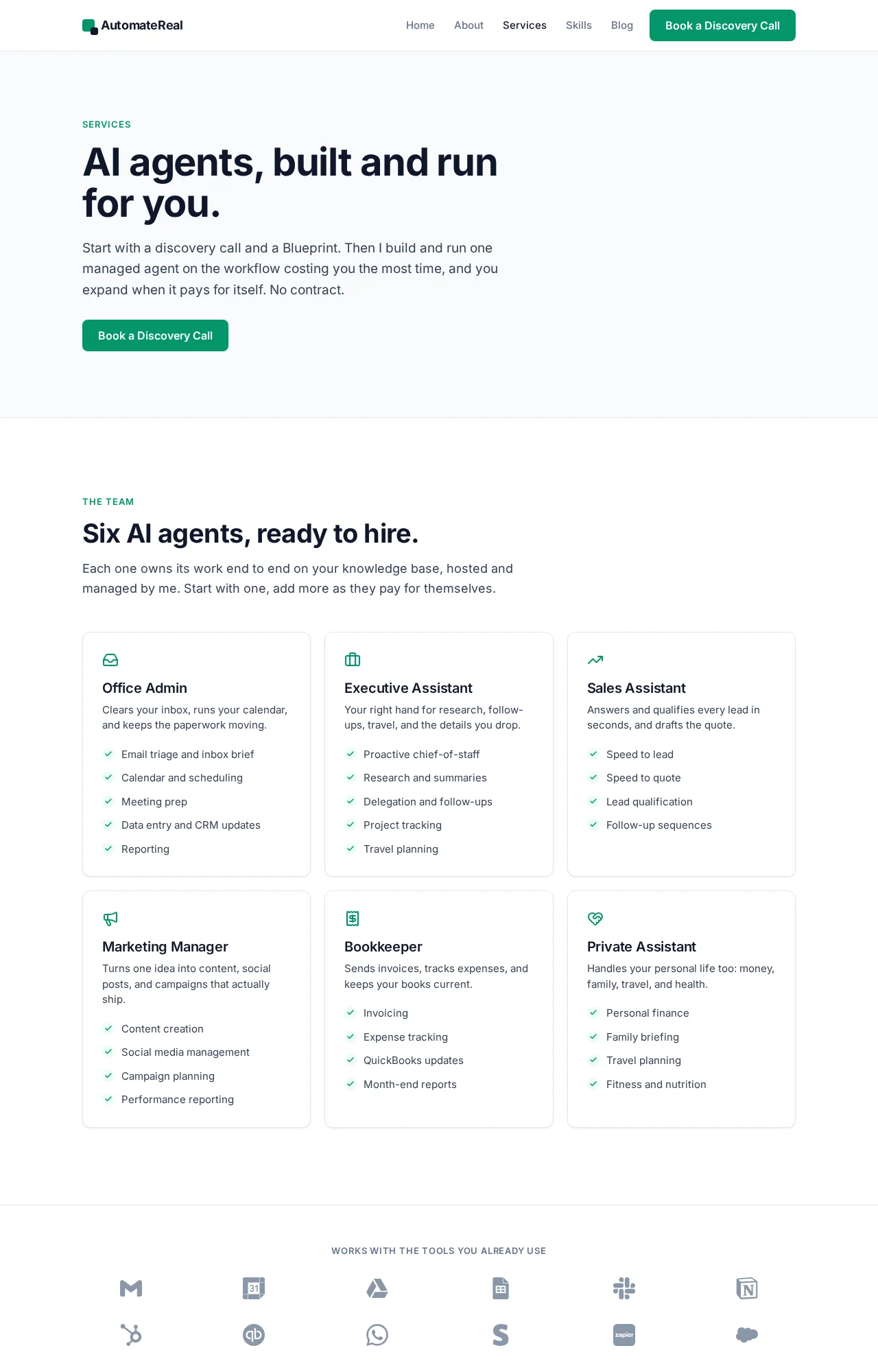
If you want help finding that first workflow, a discovery call maps it in about thirty minutes. The AI services page has the managed version, where the upkeep stays with us.
AutomateReal services
Related: Agentic AI Explained for Small Business Owners
Related: How to Build an AI Agent
Related: What Is Automation? Definition, Types, and Examples
FAQ
How are small businesses actually using AI agents today?
Mostly on the front and back ends of the day. That means inbound questions, appointment booking, quote follow-up, and answers pulled from your own docs. The SBA’s numbers put small-firm AI use in operations at 8.8%, so most owners have not started yet.
Where is the full list of AI agents for small business that I can compare?
There is no complete list, because prices move every month and tools shut down. The table on this page covers five support agents, priced from the vendors’ own pages in September 2026. Re-check each vendor page before you buy, and treat any roundup price as out of date by default.
Do I need an AI assistant for a small business, or a full agent?
Buy the assistant if you want help with work you are already doing. Buy the agent if you want a workflow to run while you are on a job. Assistants are priced per seat and agents per finished task, so the pricing model usually tells you which one you are buying.
What do business owners say about AI agents on Reddit?
The threads are mostly operators asking whether demand is real and builders comparing what they shipped. Read them for failure modes and for tools that quietly stopped working. No thread knows your workflow, and the tool a stranger loves is often the one that breaks on your data.
Is there such a thing as AI agents for small business near me?
Agents are software, so there is no local version and no license to check. What is local is the person who sets it up and answers when it breaks. Ask who owns the fix before you sign anything, and put that answer in writing.