AI Marketing Agent: What It Does for Small Businesses
An AI marketing agent plans campaigns, writes copy, and reports results on its own. See what it does for a small business, what it costs, and how to pick.
An AI marketing agent is software that plans and runs marketing work on its own. It writes copy, builds campaigns, places ads, and reports results. It follows your brand rules, works inside tools you already use, and reports back instead of waiting for instructions. Small businesses hire one to run daily marketing without adding headcount.
Here is the honest baseline. The query “ai marketing agent” earned 18 impressions and zero clicks in my last 28 days of Search Console data. Most content on this topic comes from vendors selling the agents. This is the plain version, from an operator who runs automation.
TL;DR
- An AI marketing agent plans and runs marketing work end to end. It does not just answer questions.
- You set the brand rules and the goals. It does the weekly running.
- The cheapest place to start is inside software you already pay for.
- The real cost is setup and upkeep, not the sticker price.
What is an AI marketing agent?
An AI marketing agent is software that does a marketing job end to end. It plans the steps, runs the tools, and reports the outcome without you steering each one. You set the goal and the guardrails, and it works while you handle the parts that need you. An agent is what turns a model into a worker.
IBM frames AI agents in marketing as software that plans and takes action toward a goal with the tools it is given. The same guide separates agentic AI, which acts, from generative AI, which creates content. Some call it an AI agent for marketing. The name changes, the definition does not.
Yext’s AI marketing agent comparison splits the human role the same way. With automation you build and maintain the rules. With an agent you set intent and guardrails, then approve the exceptions.
| What you are comparing | Marketing automation | AI assistant | AI agent |
|---|---|---|---|
| Who chooses the next step | the workflow you built | you, prompt by prompt | the agent |
| What it does with a result | runs the next step in the path | describes it and waits | reads it and decides |
| Where the work happens | 1 tool or a fixed chain | a chat window | inside your tools |
| Your role | build and maintain the rules | read the output | set the goal and the guardrails |
| How it fails | stops when reality differs from the rule | sounds confident and stops | acts on bad data at scale |
| What you own | the workflow | the prompt | the outcome |
The machinery inside a marketing agent
Every marketing agent runs on the same four parts. A model does the thinking. Your data and a toolset give it context. An orchestrator runs the loop, and an ops layer watches the results. What changes between tools is how those parts are wired. The orchestration loop is what makes it an agent.
IBM sorts agents into five main types, from simple reflex agents to goal-based and utility-based agents that weigh outcomes, per its types of AI agents list. The engine is a large language model. AgentOps, the layer the same guide names, tracks what each agent did. IBM’s own version is watsonx Orchestrate, and builder platforms like Vellum sell the same parts.
What can an AI marketing agent do for a small business?
An AI marketing agent runs the daily tasks that used to eat your week. It writes email campaigns and segments your list. It places Meta and Google ads, then reports the numbers back. For a small business, the payoff is the time it puts back on your calendar. The highest-value job is the follow-up that runs while you sleep.
Dozens of marketed AI marketing agent tools exist. Improvado’s testing roundup reviewed 11 AI marketing agent tools doing exactly this work. That is the practical definition of AI agents for marketing. My own outreach system pulls in roughly 200 form submissions a day, and the agent that matters to me runs the follow-up. The AI agents for small business post covers the same path.
AutomateReal skills
Which job should AI agents for marketing take first?
Start with the job that repeats every day and has an obvious right answer, like lead follow-up. Leave the creative work for later. Follow-up is where slow hours and lost leads pile up, and where a missed reply costs you a customer.
Pick a job that runs on a schedule you already keep. It should have 1 clear output you can check in a minute.
| First job candidate | Why it works as a first agent | The risk you take |
|---|---|---|
| Lead follow-up | the queue never empties and each reply needs a next step | a wrong message reaches a real person |
| Quote requests | the details arrive in a structured form | a bad number reaches a customer |
| Review replies | short, repetitive, and high volume | the tone sits on a public page |
| Content publishing | easy to read back before it goes live | brand voice drifts over weeks |
| Weekly reporting | the agent only reads and summarizes | low risk, and a soft place to start |
Follow-up was my first hand-off. Around 200 form submissions a day land in my lead system, and the follow-up now runs without me reading each one.
Pick the job by the hours it eats, not by how good the demo looks.
How is an AI marketing agent different from marketing automation?
Marketing automation runs a path you drew in advance. An AI marketing agent decides the next step as it goes. Automation sends the email on schedule. An agent reads the reply and chooses the follow-up that fits. The line between them decides what you can hand over. Automation follows the map you drew. An agent draws the map as it goes.
| What you are comparing | Marketing automation | AI agent for marketing |
|---|---|---|
| Choosing the next step | follows the path you built | picks the step that fits the goal |
| Writing the message | fills your template | drafts from your rules and your files |
| Handling a reply | sends the next scheduled email | reads the reply and decides the answer |
| Reporting | exports the numbers | reads them and says what changed |
| What it needs from you | the next step, every time | the goal, once |
| What you own | the workflow | the outcome |
The Improvado roundup treats the two as separate categories. A workflow finishes one path. An agent owns an outcome. That distinction matters when you shop for AI agents for digital marketing.
How much does an AI marketing agent cost?
The price depends on the route you take. Agents inside software you already pay for cost the least, because the tool is already in your budget. No-code builds add subscriptions plus setup hours. Custom agents add the most. The sticker price is the small number. Setup and upkeep are the real cost.
The model is the smallest line. Claude Sonnet 5 runs at $2 per million input tokens and $10 per million output tokens. Setup and review time cost far more than the tokens ever will.
Anthropic publishes those token rates on its pricing page, and a small agent sends far less text than a person expects. The plan tiers sit in the same modest range. A Claude plan runs from $0 to $17 per month on the annual rate, or $20 month to month. A Team seat sits at $20 per seat per month on annual billing.
No verified industry benchmark for marketed agent pricing exists, so the figures here are vendor list prices plus my own numbers, labeled as such.
The honest costs are the two nobody quotes. Setup covers cleaning the records the agent reads, and review covers the minutes you spend checking output every day.
| Cost line | What drives it | Who bills you |
|---|---|---|
| Model usage | tokens in and out, from $2 per million | the model provider |
| Platform subscription | tasks or operations per month, with a free tier | Zapier, Make, or your CRM |
| Setup | cleaning the data behind the first output | you, or whoever builds it |
| Review | minutes per day of approval | you |
HubSpot Breeze, now branded Agent Hub, comes with all Starter, Professional, and Enterprise editions of HubSpot. Salesforce positions Agentforce for enterprise teams inside Marketing Cloud. I budget hours, not just dollars, when I judge an agent.
The pick rule: start where you already pay
The rule I use when I map a workflow for a prospect is simple. You pick the repeat job, keep the tool, and add the agent. Start where you already pay. The cheapest integration is the one that ships inside your CRM.
Renting one more tool is the expensive move. The CRM suites priced above prove it. I build a free website for prospects before they pay. The idea is the same here: prove the value inside the tool they already own.
Can an off-the-shelf AI agent for marketing cover you, or do you need a custom one?
Off-the-shelf covers most first jobs, because the tools you already run ship with agents inside them. Go custom when your process spans systems that do not connect, or when the job moves money. Most owners never need the custom build.
Zapier’s agent builder reaches any of 9,000+ apps in Zapier’s integration library. That covers the common stacks. Custom earns its cost in 2 cases.
- Your process is unusual enough that no shipped agent matches it.
- The record the agent updates lives in a system that nothing integrates with.
Start off the shelf. Go custom when the seams show.
Will an AI marketing agent work with the tools I already use?
Yes, if you check the connector list first. Most marketing agents link to the CRM, email, and ad accounts you already run. When a direct link is missing, Zapier, Make, or n8n glue it together. The agent works inside your stack. Check the connector list before you check the benchmarks.
Integration is where the vendor demos go quiet. Klaviyo and Braze agents live where your email already lives. Jasper writes inside your content flow. An AI advertising agent for Meta Ads and Google Ads only earns its keep if it can reach the accounts.
The standard worth knowing is the Model Context Protocol, an open-source standard for connecting AI applications to external systems. The docs describe it as a USB-C port for AI applications.
| System | What the agent does there |
|---|---|
| CRM | lead scoring and qualification |
| Email, Mailchimp or Klaviyo | drip sequences and follow-up |
| Social channels | listening, replies, and content distribution |
| Ads and GA4 | campaign reporting and attribution |
| Google Business Profile | posts, photos, review generation, replies, and the local pack |
How do AI marketing agents stay on brand?
An agent stays on brand through rules you set once at setup. The rules cover how it sounds, what it offers, and where it draws the line. What it refuses to say is part of the brand too. Brand safety is a set of rules plus a human who reviews the risky output.
Those rules live in the prompts and in the knowledge base behind the agent. IBM’s guide explains retrieval-augmented generation, or RAG, the pattern that lets an agent pull from your own documents before it writes. Personalization then happens inside the guardrails, so each customer gets a message that sounds like you.
Can an AI marketing agent handle local search and Google Business Profile?
It can, if you wire it in. Agents manage the Google Business Profile posts and review replies. They run local ad placements the same way they run email. For a local business, that profile is the front door. Local search runs on the same agent playbook. The profile is the campaign.
The enterprise guides skip local. A local business sees the same agent economics on its own profile. The front door is the first job worth handing off.
Where the vendor demos stop
The demo ends where the real work starts. An agent in production needs clean data, clear rules, and regular attention. Those three keep it honest, and none of them ships in the demo. The brand and the budget are the two things it cannot lose. The demo shows the happy path. The upkeep is the real job.
Your CRM needs clean fields, or the agent segments on garbage. Your ad account needs budget caps, or a bad week spends it.
That is why the AI agents for marketing agencies post starts with the same warning. My own setup proved it: the agent followed the rules I wrote, then the holes in them until I fixed them. That kind of week is why the demo never closes a deal with me. The live stack decides.
Where do marketing AI agents break in the first month?
The rules you wrote have holes, and your tools change underneath the agent. Approvals pile up, and a mistake repeats until you correct the rule it came from. The agent follows your rules, not your intentions. Expect a bumpy first month, then a steady drop. A rule written wrong stays wrong until you fix it.
That is true for every agent I have run, including my own follow-up automation. The fix was boring and repeatable: watch the output, tighten the rule it broke.
Mine shipped 2 defects in week one. It wrote the same record twice. The link on that record pointed at a directory page instead of the post you can actually apply to. Both reached the channel, because nothing sat between the agent and the send button.
| Failure | What you see | The check that catches it |
|---|---|---|
| Duplicate record | the same job posted twice | dedupe on the record ID before send |
| Wrong link | a landing page instead of the source post | a human opens the link before it ships |
| Rule with a hole | the same wrong output every run | a rule review in week 1 and week 4 |
| Dirty field | routing or segmentation on junk | a field audit before the agent runs |
| Silent stop | nothing shows up for a day | a daily count on the output channel |
The agent cannot see the gap between your rule and your intent.
The three-check gate before anything ships
One rule covers most of the risk. Nothing customer-facing leaves the box until a person has run 3 checks. They take about 2 minutes, and they catch the failures a written rule cannot see.
- Open the record and confirm it names the right thing.
- Click every link and confirm it lands where the customer expects.
- Read the message once as the customer, not as the builder.
NIST published the formal version of this thinking. Its AI Risk Management Framework is built for voluntary use and landed on January 26, 2023. The stated goal is to build trustworthiness into an AI system at every stage, from design through evaluation.
A gate is that idea at the scale of one workflow. The cost is a few minutes a day. What it protects is the trust of the person reading the message.
A 3-check gate catches what the rule cannot see.
How do you know an AI marketing agent is working?
Pick one number before you switch the agent on, like leads or booked calls. That number decides whether the agent stays. A dashboard full of numbers is not proof. Everything else is reporting noise. The agent either moves your one number or it goes. One metric decides whether the agent stays. Pick it before you start.
Reporting is where agents earn trust, because you can read the work in a dashboard. Start with the honest baseline you already have, like a Search Console export. An agent that moves that number moves your business.
What’s the difference between an AI agent and an AI assistant?
An assistant waits for a question and answers it. An agent takes a goal and finishes the work. Vendors blur the line on purpose, so check one thing: does it act, or does it just reply? The action is the difference, and the difference decides what you can hand over. An assistant answers. An agent finishes.
IBM’s AI agents in marketing section draws the same line between the two. The same models power both modes, from ChatGPT to Claude to Gemini.
Four ways to run a marketing agent
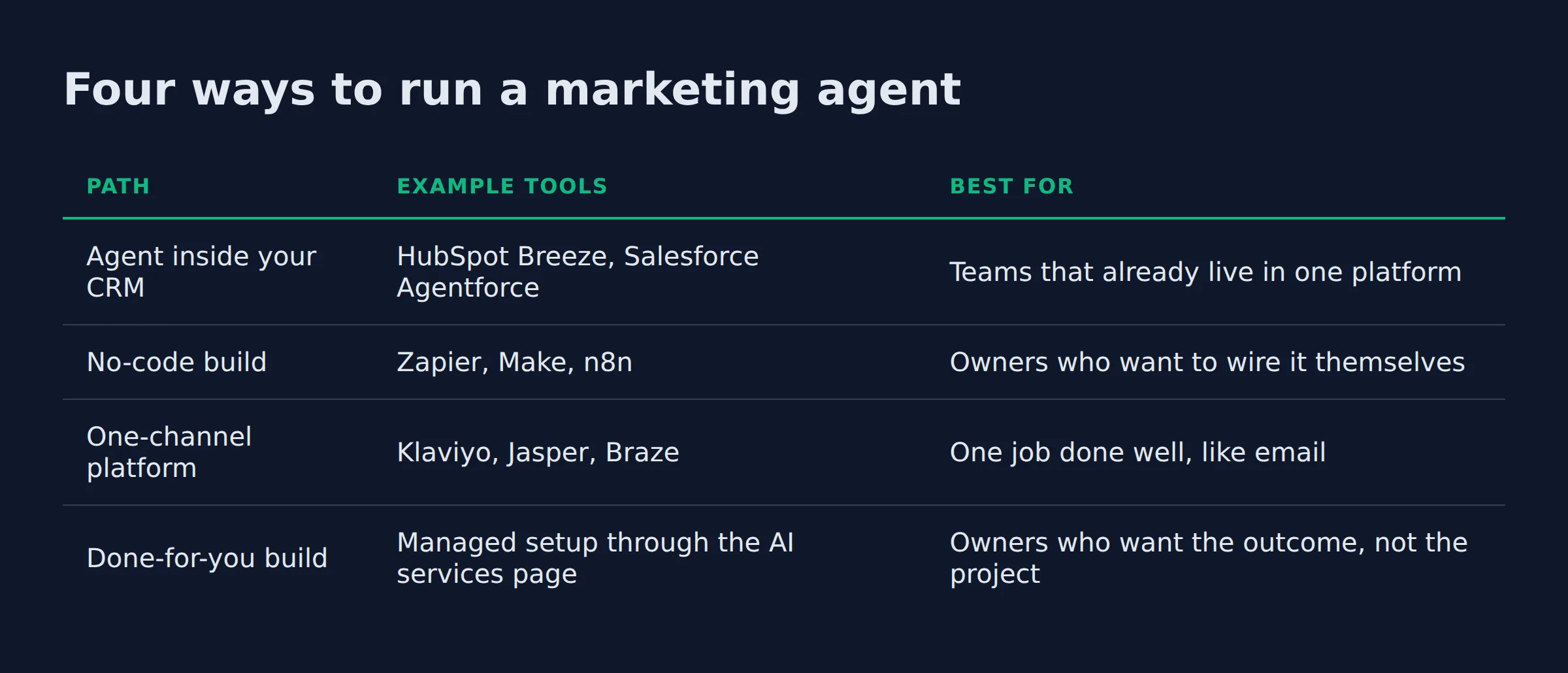
You have four ways to run a marketing agent. The right one depends on your stack and your hours. None of them needs a developer, and one of them is already inside your budget. Match the route to the job and to how much time you have. The tool is a slot. The workflow you point at it is the win.
| Path | Example tools | Best for |
|---|---|---|
| Agent inside your CRM | HubSpot Breeze, Salesforce Agentforce | Teams that already live in one platform |
| No-code build | Zapier, Make, n8n | Owners who want to wire it themselves |
| One-channel platform | Klaviyo, Jasper, Braze | One job done well, like email |
| Done-for-you build | Managed setup through the AI services page | Owners who want the outcome, not the project |
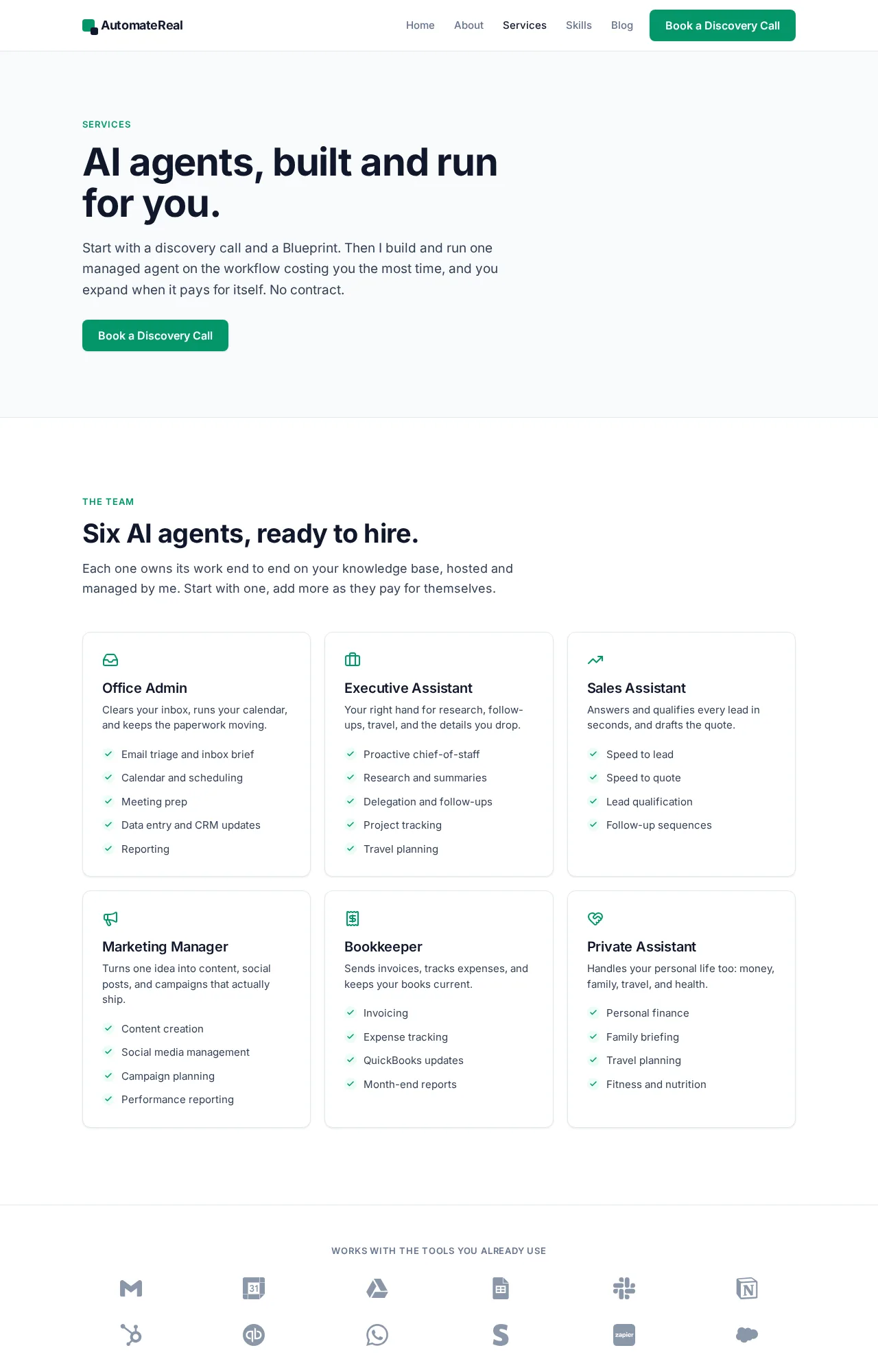
The last row is the one most solo owners should read twice. A managed build swaps setup weekends for one monthly number. The AI services page covers that route.
AutomateReal services
How long does it take to set up an AI marketing agent?
Ready-made agents inside your CRM can run in an afternoon. A no-code build takes a weekend plus tuning. Custom agents take weeks, because the workflow design comes first. The rule is the same at every length. The tool is never what slows you down. Workflow design decides the timeline.
It depends on where you start. Agents that ship inside your existing tool cost hours, because the integration already exists. Custom builds cost weeks, and most of that time goes to deciding what the agent should own.
What still needs a human?
An AI marketing agent still needs a human for the judgments. The strategy stays yours. So do the tone and the final approval. The agent does the work, and a person answers for it. Ownership stays with whoever signs off. The agent runs the campaign. The owner still chooses the bet.
Three things wait for a person: anything a customer reads, any change to ad budget, and any deletion. An agent can draft all 3 and stage them for review. Sign-off stays human.
The vendor pages skip this for obvious reasons. Campaigns fail for reasons agents cannot see, like a market shift or a brand decision. Keep the loop small: the agent drafts and you approve before it ships. That is the shape my own automation uses.
Which AI marketing agent is best for a small business?
The one inside software you already pay for. HubSpot users start with Breeze. Salesforce shops start with Agentforce. On a mixed stack, Zapier, Make, and n8n all work.
A roundup of AI agents for marketing platforms names the price and the stopping point of each option. HubSpot Breeze comes with paid HubSpot Hubs, and it works best when HubSpot is your system of record. Agentforce is consumption-based on top of Marketing Cloud licenses, and setup expects an admin.
Zapier covers the widest app list and constrains long multi-step reasoning. Make handles heavy branching and takes longer to learn. n8n is free to self-host, which suits teams with data rights to respect.
| Platform | Best when | Where it stops |
|---|---|---|
| HubSpot Breeze | HubSpot is your system of record | data outside HubSpot needs another tool |
| Salesforce Agentforce | Marketing Cloud and Data Cloud are already paid for | setup needs a Salesforce admin or partner |
| Zapier | your stack is many tools and none dominates | long multi-step reasoning gets constrained |
| Make | the workflow branches a lot | the learning curve is steeper |
| Relevance AI | the work is data-heavy, like segmentation and reporting | tiers gate features in stages |
| n8n | data has to stay on your own infrastructure | you host and maintain it |
Buy the agent inside the tool you open daily, then give it 1 job.
Related: What Is Automation? Definition, Types, and Examples
Related: How to Build an AI Agent
Related: Agentic AI Explained for Small Business Owners
FAQ
Do AI marketing agents replace a marketing team?
They replace repetitive campaign work, not judgment. One owner with an agent can run the daily email, ads, and reporting a small team used to carry. Strategy, tone, and final approval still sit with a human.
What access does an AI agent for marketing need, and what should it never get?
Give it read access to the records it works from. Give it write access to 1 destination, such as a draft folder or a team channel. Never hand over banking access or admin credentials. A read-only start proves the workflow without risking the account.
How are small businesses using AI agents right now?
Most start with 1 workflow. Lead follow-up, the weekly report, listing and profile updates, and first-draft content are the common ones. Adoption is still early, since fewer than 20% of the smallest US firms report using AI in any business function at all.
Most of the fear around these agents is vendor noise. Start small, prove one workflow, and read the numbers weekly. If you want help pointing your first agent at the right job, a discovery call maps it in about thirty minutes.