AI agents for law firms: 2026 guide
What a legal AI agent does at a law firm, what it costs a small practice, and what the ABA and state bar rules require before you trust one.
A judge fined two lawyers $5,000 for filing six cases that never existed. The citations came out of a ChatGPT session, and nobody checked them before they reached the court.
AI agents run legal work for a law firm: intake, scheduling, document drafting, contract review, and client follow-up. A legal AI agent finishes the task end to end and hands the result to a lawyer, who reviews and signs every output. Small and solo firms use them to cut admin hours, never to replace legal judgment. Cost is modest, and off-the-shelf tools cover most needs.
Most pages on this topic come from vendors selling a seat, so the recommended tool is the vendor’s own. This is the buyer’s version, with the bar rules cited, the prices printed, and the failure modes named.
My own Search Console shows “ai agents for law firms” at 12 impressions and an average position of 82.4 over 28 days. The related query “ai agents for legal” sits at 5 impressions and position 84.6. Both brought zero clicks. That is the honest baseline.
TL;DR
- An AI agent completes a task end to end. Legal research software answers a query, and a chatbot answers what you type.
- Firms use agents for intake, scheduling, drafting, review, and follow-up. An attorney reads every output.
- Small-firm seats run $20 to $99 a month. Enterprise suites run $1,200 to $2,000 a seat, and most carry a seat minimum a small firm cannot meet.
- ABA Formal Opinion 512 and the 2026 California guidance set the rule: the lawyer answers for everything the agent produces.
- Advice, signatures, and anything filed with a court stay with a licensed lawyer.
What is a legal AI agent?
An AI agent is software that plans and carries out a task on its own, then hands the result to a person. A legal AI agent points that at the firm’s repetitive jobs, like client intake or document review. A large language model powers the steps, and a lawyer answers for every one of them.
IBM defines an AI agent as a system that autonomously performs tasks by designing workflows with available tools, per IBM’s explainer. Agents lean on large language models to reason step by step, and they call outside tools when the job needs them. Thomson Reuters describes agentic AI as planning and executing a multi-step legal process under human oversight, per its explainer.
Two words in the name matter. “Legal” means privileged client work, so the confidentiality rules apply. “Agent” means the software acts, so the supervision rules apply.
If you searched for the agency-law meaning, a person acting for a principal under a power of attorney, that reading lives in legal agent meaning.
The word “agent” means the software does the job, not just the talking.
Is a legal AI agent the same as a chatbot or a research tool?
They are different products, and the difference decides what you buy. A chatbot answers in a chat window. A research tool like Westlaw or Lexis+ AI finds and cites sources. An agent carries the job end to end and hands the result to a person.
| Chatbot | Research tool | AI agent | |
|---|---|---|---|
| Runs the job end to end | No | No | Yes |
| Returns sources you can check | Sometimes | Yes | Depends on the build |
| Needs a human final call | Yes | Yes | Yes |
The split matters because of who answers for the output. A chatbot that produces a weak paragraph wastes typing time. An agent that files a weak document reaches a court with the firm’s name on it. Confusing a research tool with an agent is how firms overpay for a better search and never automate the work that eats the week.
One is a better search. The other is a worker.
What can AI agents do for a law firm day to day?
Agents take the rote first pass off the attorney: intake, scheduling, conflict checks, drafting, contract review, research, and follow-up. Every job ends in the same place, a lawyer’s review queue. The hours that used to vanish into admin come back to billable work.
| Task | What the agent does | What the attorney still does |
|---|---|---|
| Client intake | Qualifies the matter, captures facts, books the consult | Approves the intake, decides on the case |
| Scheduling | Books, reschedules, sends confirmations | Nothing, once the rules are set |
| Conflict checking | Screens new matters against existing ones | Clears the conflict |
| Document drafting | First drafts of standard clauses and letters | Edits and signs |
| Contract review | Flags clauses against your playbook | Sets the terms, negotiates, signs |
| Legal research | Finds sources, summarizes arguments | Checks every citation, reads the cases |
| E-discovery | Screens documents for keywords and privilege | Sets the scope, reviews the hits |
| Deadline tracking | Pulls dates from filings, reminds the team | Confirms the dates, owns the docket |
| Client follow-up | Keeps the thread warm, chases missing documents | Handles anything that reads as advice |
Adoption reflects the promise. The American Bar Association survey found 30.2 percent of attorneys use AI-based tools, up from 11 percent a year earlier. The gain splits by firm size: 18 percent of solo attorneys use AI, while 46 percent of firms with 100 or more attorneys do. The solo practitioner is where the upside sits.
Vendor pages put contract review at 2 to 3 hours down to 10 to 15 minutes, per one overview. No measurement stands behind that figure. The one measured number in this space is an error rate. Stanford’s RegLab ran the first preregistered test of the biggest research tools and found that Lexis+ AI and Westlaw AI-Assisted Research hallucinate between 17% and 33% of the time.
I run an agency, and the automation that changed my week was not the flashy one. My outreach pipeline pushes about 200 form submissions a day through a router and follow-up automation, so no warm lead goes cold. A legal intake agent is the same build, with a lawyer at the end of the queue instead of an autoresponder.
A first pass is worth paying for. The review stays yours.
Which AI agents are best for a small law firm?
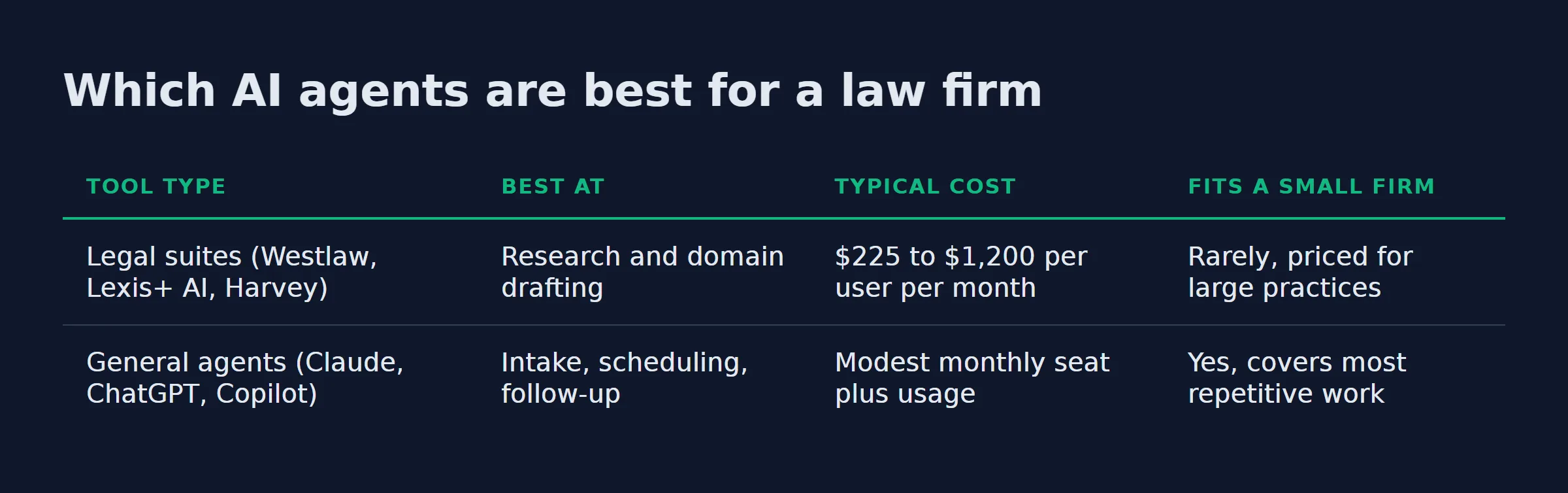
No single one, and the pick is made per job, not per brand. Start with the job that repeats every week and ends in a document you already check. Intake and contract review are the usual first picks. A general agent covers both, and a research suite earns its seat only when research volume pays for it.
| Tool | Built for | Reported price | Fits a 2-lawyer firm |
|---|---|---|---|
| Harvey | Enterprise research and drafting | $1,200 to $2,000+ per seat per month, on a 25-seat minimum | No |
| Legora | Collaborative matter work | $300 to $800 per seat per month, on a 10-seat minimum | Rarely |
| CoCounsel Legal | Research and drafting on Westlaw | $225 to $400+ per seat per month | Maybe |
| Lexis+ with Protégé | Research across the Lexis content set | Quote only, buyer medians of $14,400 to $18,450 a year | Maybe |
| Spellbook | Contract review and drafting | Reported $20 to $99 per user to start | Yes |
| Microsoft 365 Copilot | Redlining, drafting, and firm admin | $30 per user per month, paid yearly | Yes |
| Claude or ChatGPT team plans | Intake, scheduling, follow-up | Near $25 to $30 a seat | Yes |
The wall is the seat minimum. Harvey’s reported floor runs about 25 seats on a 12-month term, per a legal AI pricing analysis. That works out near $360,000 a year before add-ons. Legora’s reported entry ticket lands near $30,000 a year on a 10-seat minimum. A 2-lawyer firm cannot buy either one.
The cheaper end has more room. Clio adds its AI features for a reported $49 to $59 per user on top of the base plan, per a 2026 pricing comparison. Luminance, Robin AI, and Ironclad sit in the same contract workflow as Spellbook. Relativity aiR covers e-discovery, and EvenUp drafts demand packages for injury practices. Filevine and Smokeball carry AI inside firm operations instead of beside them.
Microsoft’s Legal Agent in Word reviews a contract clause by clause against a playbook and cites the source language behind each redline, per Microsoft. It ships inside Copilot, so the review stays in the file the firm already sends.
Compare the seat minimum before the seat price. The floor decides who can buy.
How much do AI agents cost a law firm?
A 2-lawyer firm can run intake and contract review for $60 to $200 a month in seats. The expensive suites price for large practices. The real cost is not the sticker. It is the setup, the upkeep when an app or a rule changes, and the hours spent teaching the agent the firm’s own documents.
| Firm size | Seat floor | Adding a research suite |
|---|---|---|
| Solo attorney | 1 Copilot seat, $30 a month | $225 to $400 per user for CoCounsel Legal |
| 2 lawyers | 2 seats, $60 a month | $450 to $800 a month |
| 5 lawyers | 5 seats, $150 a month | $1,125 to $2,000 a month |
Microsoft charges $30 per user per month for Copilot on the annual plan, per Microsoft, and $31.50 on monthly billing. The table is arithmetic on published seat prices, not a quote.
The combined number for a small firm is modest. The hours are not. I run my own follow-up on the same shape, and the subscription is the smallest part of that build. The rules took longer to write than the wiring.
Can a small firm get one free, or build one without code?
Free tiers cover drafting and research. No-code builders such as Zapier, Make, and n8n can connect intake to a calendar. The free route costs hours instead of dollars. Run it on one job for a month before you pay for a seat. Price does not change the error rate, so the review step survives on either route.
Judge the price against the task you stop doing, not against the tool next to it.
Can an AI agent handle legal intake and inbound client calls?
Yes, at the front of the funnel. An intake agent captures the caller’s details, qualifies the matter against the firm’s criteria, and books the consult. It cannot give advice or quote a fee, and a person reads every call it flags.
An AI receptionist for a small business is the same job without the legal layer, and its prices are published. Smith.ai charges $300 a month for 30 calls on the starter plan, per its pricing page, and $2,100 for 300 calls. Ruby charges $250 a month for 50 minutes of reception and $395 for 100 minutes, per its pricing page.
The limit on the legal side is a rule, not a missing feature. The State Bar of California says a lawyer must not let a system communicate legal advice or act in a representative capacity without meaningful supervision and review, per its guidance.
An intake agent can qualify a caller. It cannot advise one.
Can off-the-shelf AI agents cover a law firm, or is custom required?
Off-the-shelf general agents cover most of the repetitive work a small or solo firm does: intake, scheduling, drafting scaffolds, and follow-up. Custom work pays only where the firm has a distinctive process, like its own intake rules or docket process, and even then it starts from the same off-the-shelf core.
Start with the general agent, point it at one repeating task, and go custom only when a workflow proves worth automating further. I would run the first month on a stock agent before I paid for custom work. Newness is not a weakness to hide. Anyone selling a decade of agent experience inside law firms is selling you something.
Start off the shelf. Go custom when the seams show.
What do the bar rules say about legal AI agents?
The position is one line long: the attorney stays responsible for everything an AI agent produces. No bar has banned AI in practice. ABA Formal Opinion 512, issued July 29, 2024, applies the existing ethics duties to generative AI output, per the opinion.
| Bar duty | What it means with an AI agent |
|---|---|
| Competence | Learn the tool, review the output, check the citations |
| Confidentiality | Client data stays protected when a tool processes it |
| Communication | Tell the client how AI is used when it affects the matter |
| Meritorious claims and candor | File nothing you cannot stand behind, AI-made or not |
| Supervision | Oversee the people and systems doing firm work, tools included |
| Reasonable fees | Bill AI-assisted work the same way you bill the rest |
The State Bar of California issued its 2026 practical guidance at the request of the California Supreme Court, replacing the November 2023 version. It names 3 duties for agentic work:
- Competence and diligence (Rules 1.1 and 1.3)
- Confidentiality (Rule 1.6 and Business and Professions Code section 6068(e)(1))
- Supervision of nonlawyers and technology (Rules 5.1 to 5.3)
The supervision rule carries the most weight for an agent. The guidance says competence requires a lawyer to supervise technological agents, and it warns that more autonomy in a system means more verification around it.
Leaving the output unchecked is not hypothetical. In Mata v. Avianca, a lawyer asked a chatbot to confirm a case it had cited, per the court record on CourtListener. The chatbot doubled down. The case did not exist. Judge P. Kevin Castel fined the lawyers $5,000 on June 22, 2023, and ordered letters to the judges whose names the invented opinions borrowed.
Fabricated citations are a documented failure mode, with the fine printed in the record.
Do law firms need to worry about confidentiality?
Yes, and the bar has said so in writing. Model Rule 1.6 applies to an agent the same way it applies to a clerk. Opinion 512 says a lawyer must protect client information when using generative AI. The California guidance says lawyers must not hand material client information to a tool without informed consent.
Confidentiality questions turn into vendor questions:
- Does the vendor train its models on your matter data?
- Is the data encrypted in transit and at rest?
- Does the vendor hold a SOC 2 Type II report?
- Where does the data live, and how long is it kept?
- Who at the firm can read the agent’s logs?
Get the answers in writing. For governance, the NIST AI Risk Management Framework is the named baseline.
The duty sits with the lawyer, and a vendor’s terms cannot carry it.
Do lawyers have to tell clients they use AI?
Not always, but often yes. Opinion 512 ties AI use to the duty to communicate. Rule 1.4(b) obligates lawyers to explain matters to the extent reasonably necessary, so the opinion tells lawyers to weigh disclosure. The safe default is to tell the client when a tool touched the matter.
When a client asks how the work was done, the answer should be straight. The client learns it from you, not from a surprise later.
Disclosure is a communication duty, not a technology debate.
Where the agent has to stop
Three things stay with a licensed person: advice, a signature, and anything that reaches a court or a client as a legal position. If an agent makes a mistake, the attorney answers for it. Opinion 512 says the lawyer remains responsible for competent legal services, even when a tool did the drafting.
I use a 3-line stop rule when I wire an agent into a workflow:
- Stop before anything that leaves the building under the firm’s name.
- Stop before any output a client will read as advice.
- Stop before any date a court or a contract depends on.
The same gate runs inside the pipeline that produced this page. It runs five agents, and one of them is a reviewer whose only job is to reject a draft that fails its brief. A firm’s review queue is the same thing with a license attached.
The fine lands on the lawyer, never on the software.
The 5 checks before you trust a legal AI agent
Each check maps to a duty named in the bar rules, so the list stays short and testable. The state bar guidance bars reliance on automated output without meaningful review.
- Verify every citation against a real reporter or database. Mata shows the price of skipping it.
- Read every draft the agent produces before it goes anywhere. That is the duty of competence, not a preference.
- Ask where client data goes and who can see it. Get the answer in writing.
- Name an attorney who signs off on each matter. Supervision is a named duty.
- Keep the tool out of the practice of law. The software gathers and drafts. The lawyer advises and signs.
Run the five checks before you buy, and again every month after.
The first month is a tuning loop
Expect a tightening loop after the agent goes live. It follows the rules you wrote, including the gaps, so one bad rule repeats until someone fixes it.
- A rule with a hole, so the wrong reply reaches a client twice.
- An approval step nobody owns, so matters sit in the queue.
- A platform update that changes an API the intake form depends on.
- A report nobody reads, which hides a job the agent stopped doing.
Watch the first week of output closely, and name one person as the owner of the loop.
A named owner for the loop is the difference between a tool and a system.
How I’d build a legal intake agent
Legal intake automation is three pieces, and only one of them must be human.
- The form captures the matter details.
- The router sends each intake to the right queue.
- A licensed human owns the review step.
AutomateReal skills
Integration is a data path. The agent reads a new matter from intake and writes the result back to the matter file in Clio, Filevine, or Smokeball. A missed write becomes a missed date, so a person owns the handoff no matter how smooth the vendor claims the setup is. A first agent on one job takes days, not months, when it reads from software the firm already runs. The real timeline is the tuning week after the first live call.
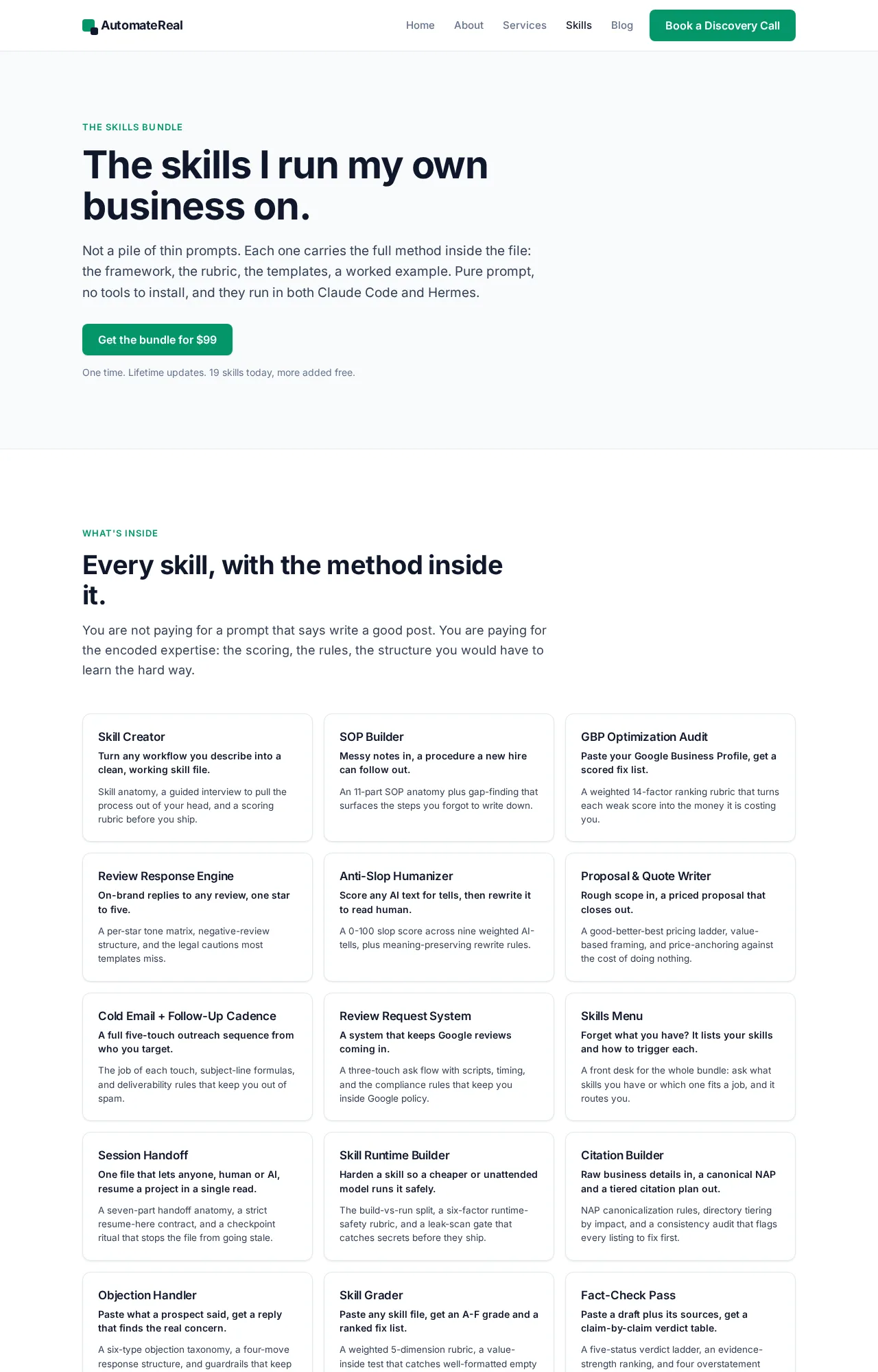
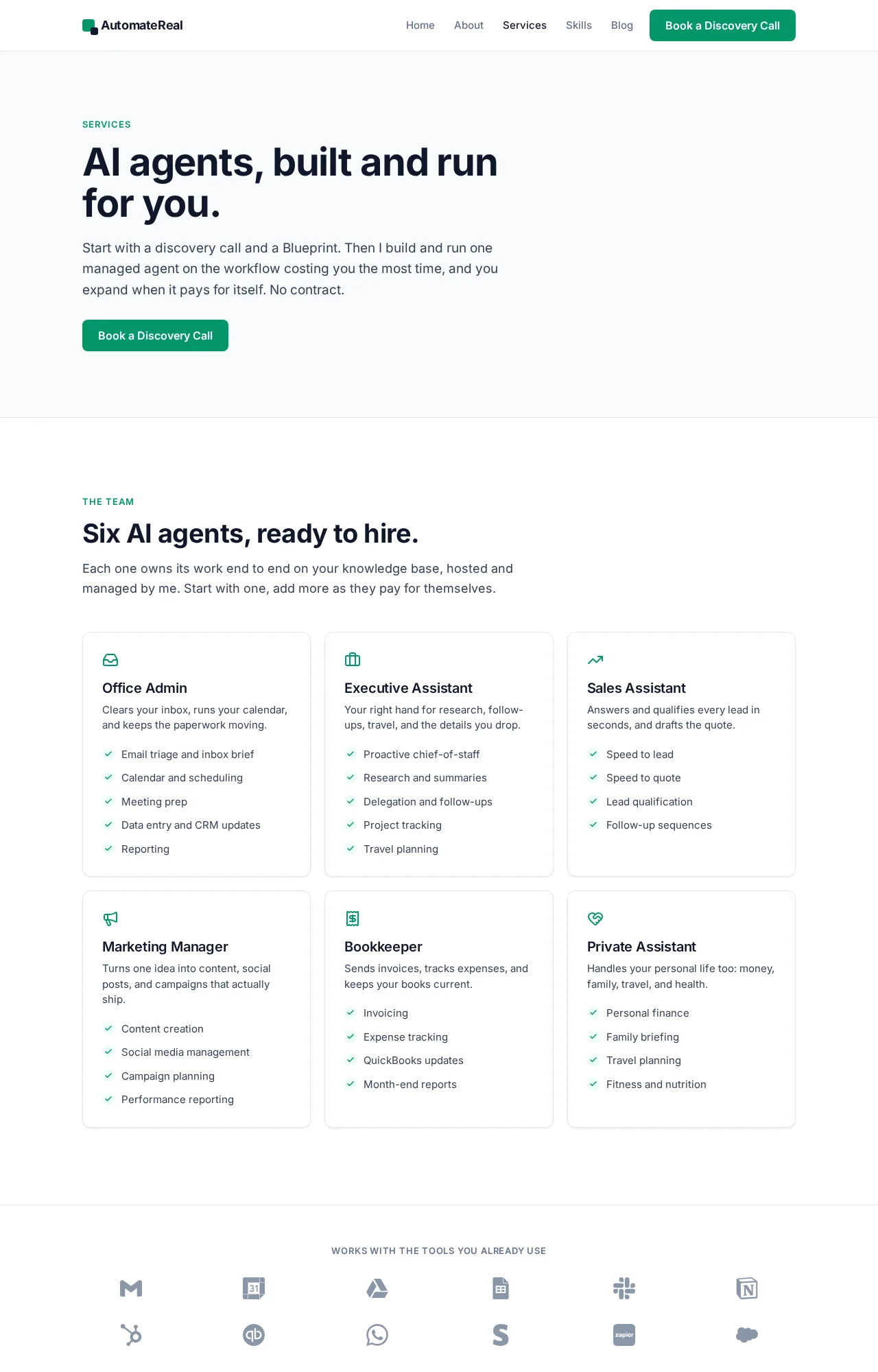
The piece I would never automate for a law firm is the review. No output reaches a client or a court without a lawyer’s name on it. If you want to run it yourself with the prompt patterns already mapped, the skills bundle is the starting point. If you want it built and kept running, the AI services page covers the managed route.
AutomateReal services
The same three-piece shape shows up across service businesses, and I walked it for dental practices.
The review step is the product. The model is the easy part.
Related: AI agents for small business
Related: Which AI Agent Should You Build First?
Related: Lindy AI: What It Costs and Who It Is Actually For
FAQ
Is Claude or ChatGPT better for lawyers? Neither wins outright, and the right pick is per job. Both are strong general agents for the admin a lawyer should offload, intake, scheduling, and follow-up. Try one on a single repeating task, keep privileged documents out of any public chat, and judge it on that job before you standardize.
Is there a ChatGPT for legal? Yes, the legal-specific suites are the closest thing: CoCounsel, Harvey, and Lexis+ AI are tuned for legal research and drafting. General ChatGPT still handles the firm’s admin well, so many small firms pair a general agent for operations with a legal tool only when research volume justifies the seat cost.
Which AI agent is best for a solo attorney or a 2 lawyer firm? For most solo and 2 lawyer firms, a general agent on a basic seat covers intake and follow-up. Add a contract tool once contract work repeats every week. Add a research suite only when the research load pays for a $225 seat.
Are AI agents allowed under legal ethics rules? Yes, with conditions. No bar has banned AI in practice. The rules impose duties of competence, confidentiality, and supervision. An agent that drafts under review is fine. An agent that answers a client unsupervised is the edge that gets lawyers in trouble.
What is the difference between Harvey or CoCounsel and a general AI agent? Harvey and CoCounsel Legal are research and drafting suites priced per seat for firms with a legal ops budget. A general agent runs the admin around a matter for a fraction of that price. Most small firms need the second one first.
Can an AI agent replace a paralegal? No. An agent removes the repeatable first pass. The review and the client contact stay with a person. The bar rules require lawyer supervision of every output. A firm that drops that step to save a salary is buying the Mata outcome.
Do I need technical skills to set one up? No. A first agent is a rules document plus a connection to your intake form. The judgment it needs is the judgment you already have, which is knowing which output is right and which one is risky.
If you want help finding that first workflow, a discovery call maps it in about thirty minutes.