Legal agent meaning: AI agents, agency law, and Word
A legal agent can mean an AI tool that finishes legal work, a person acting for a principal, or Word's redlining feature. Which one do you need?
Search “legal agent” and the top results disagree with each other. One sells software. One explains a court appointment. One is a Microsoft product page.
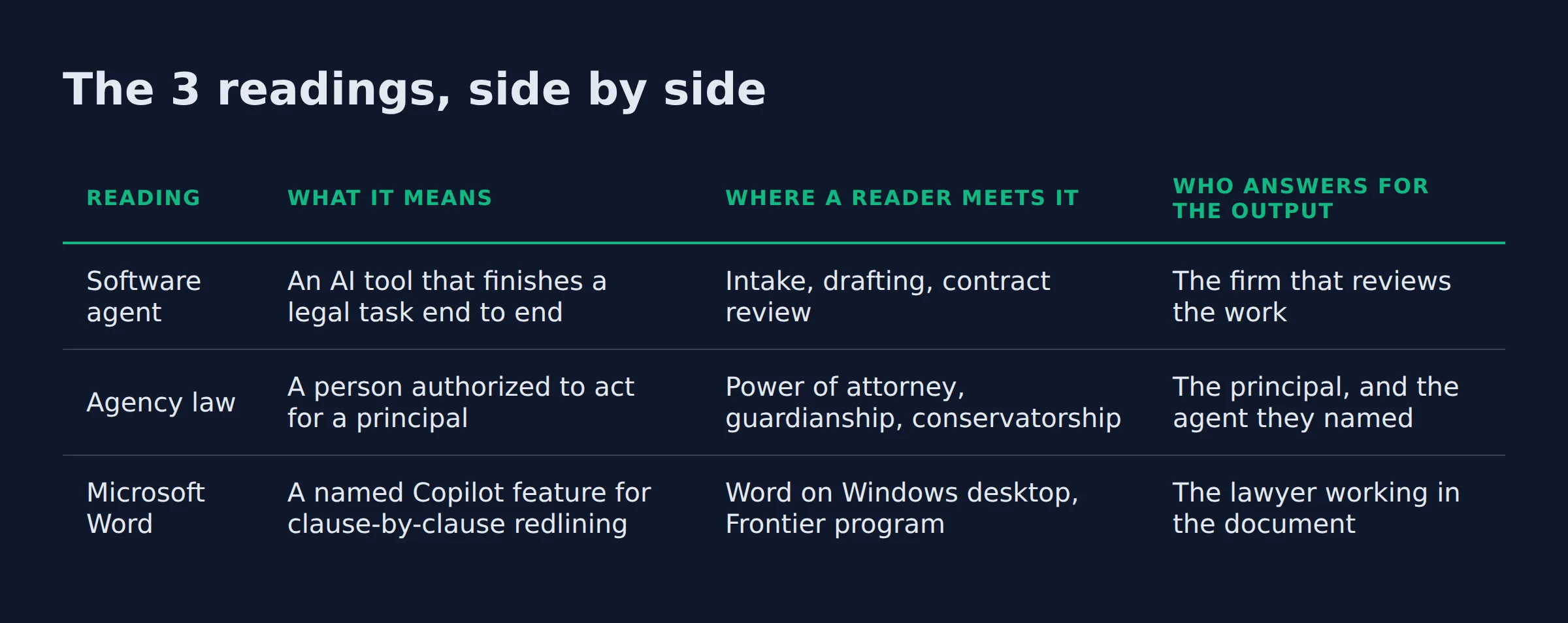
The term legal agent covers 3 different things. In law, it means a person authorized to act for another person, called the principal. In software, it means an AI tool that finishes a legal task end to end. In Microsoft Word, the same words name a Copilot feature for contract redlining.
Most pages ranking for this term pick one meaning and stop. This one walks all 3 in the order a reader meets them, with the rules cited.
TL;DR
- A legal agent can be software that finishes legal work. It can also be a person who acts for a principal, or a feature inside Microsoft Word.
- Only one of the 3 changes your week. The other 2 tell you which meaning a vendor is using.
- An agent can draft the work. A lawyer advises the client and signs.
- The ethics rules do not relax because a tool did the first pass.
What is an AI legal agent, and what does it do that a chatbot does not?
An AI legal agent finishes a legal task end to end. It reads the matter, drafts the work, and places the output where the next person needs it. A chatbot answers the question you typed, then stops. The gap between the two is what you are paying for.
That is the reading behind most searches for ai agents for legal. California’s guidance describes agentic systems as tools that run tasks or workflows without a person prompting each step. It names client intake as one example per the State Bar of California guidance.
My own outreach pipeline runs on that shape. Around 200 form submissions a day arrive, get read, and land in a queue with the next step already chosen. The drafting is automated. Tool calling moves the record to the next system. The decision to send is mine.
The intake build and the vendor questions live in what a legal AI agent does at a law firm.
A chatbot hands you text. An agent hands you a finished task.
What is the legal agent inside Microsoft Word?
The Legal Agent in Word is a named product inside Microsoft 365 Copilot. It reviews a contract clause by clause against a playbook you supply. Then it applies each edit in the document so a counterparty can see every change.
If you searched for the Microsoft Word legal agent, you landed on a product name. Microsoft published the Legal Agent in Word on 30 April 2026 and shipped it to the Frontier early-access program, built in close collaboration with legal engineers. The announcement groups the work into 6 capabilities:
- Understand complex legal documents.
- Draft precise edits.
- Negotiate with confidence.
- Review contracts against your playbook.
- Maintain trust and control.
- Keep sensitive workflows secure.
The announcement describes the redlining engine as a purpose-built insertion algorithm with a deterministic resolution layer. It credits that design for lower latency and lower cost. Auditability comes from the same setup, since every edit stays visible in the document.
Availability is narrow today. It runs in Word on Windows desktop and sits in the agents dropdown. No installation is needed, though Word may need a restart. The same post states the feature does not provide legal advice.
In Word, legal agent is a product name for clause-by-clause redlining inside one editor.
What is a legal agent under agency law?
Under agency law, a legal agent holds legal authority to act for another person. That person is the principal, and the tie between the two is a principal-agent relationship. The relationship can be created intentionally or by implication. It shows up in power of attorney, guardianship, and conservatorship.
The legal agent definition in agency law is the oldest of the 3 readings. Cornell’s Wex entry describes the principal-agent relationship as one where the agent is authorized to act on behalf of the principal. That covers more ground than a software demo.
- Power of attorney. One person grants another the authority to act for them, usually through a written document.
- Guardian. A guardian is appointed by a court to manage the affairs of someone who cannot manage them. A ward can be a minor child or an incapacitated adult.
- Conservator. Cornell’s Wex entry puts a conservator in charge of another person’s affairs.
Agency law describes a person. Software took the same word for a tool.
The 3 readings, side by side
| Reading | What it means | Where a reader meets it | Who answers for the output |
|---|---|---|---|
| Software agent | An AI tool that finishes a legal task end to end | Intake, drafting, contract review | The firm that reviews the work |
| Agency law | A person authorized to act for a principal | Power of attorney, guardianship, conservatorship | The principal, and the agent they named |
| Microsoft Word | A named Copilot feature for clause-by-clause redlining | Word on Windows desktop, Frontier program | The lawyer working in the document |
I pulled the pages ranking for this term and measured what each one covers. The numbers below are my own count of the extracted text.
| Page ranking for “legal agent” | Length | Covers | Skips |
|---|---|---|---|
| Microsoft’s Word Legal Agent announcement | ~650 words | Frontier access, clause-by-clause redlining | Agency law, AI outside Word, every ethics duty |
| A senior-living law firm’s agency guide | ~1,050 words | Power of attorney, guardian, conservator | AI agents, small firms, other industries |
| A vendor blog on AI agents for lawyers | ~2,342 words | Agent versus chatbot for in-house teams | The bare term, and the solo practitioner view |
None of the 3 answers the question a reader typed. That gap is the reason this page exists.
One table beats 3 paragraphs when a term carries 3 meanings.
Should a small business or firm hand legal work to an AI legal agent?
Yes for the work a person reviews before it ships. Intake, scheduling, and first drafts all fit that test. No for anything that counts as legal advice, which stays with a licensed lawyer. The task sets the boundary, and it is worth writing down.
California’s guidance scales attorney supervision to the autonomy of the system. The more a tool does on its own, the more a lawyer has to verify per the guidance. That sentence belongs next to any purchase decision, and it holds for any ai agent for business.
I test tools the same way I sell. I build a free website for a prospect before they pay me anything, because a working demo answers what a brochure cannot. Run an agent on one task for 2 weeks before you buy the platform.
The AutomateReal skills page, one of the demos built before any invoice.
The day-to-day version for a firm, task by task, sits in AI agents for law firms.
Set the boundary per task, and write it into the workflow.
The 4 checks I run before an agent touches a matter
I run the same 4 checks on every agent before it gets near real work. They come out of my own systems, where the agent drafts and I decide what ships.
- Access. What can the tool read, and where does that data go?
- Autonomy. How many steps run before a person sees anything?
- Verification. Can I check every citation against a real source?
- Sign-off. Whose name goes on the result?
The competence duty is what makes check 3 non-negotiable. A lawyer who cannot verify an output cannot rely on it. Hallucinated citations are the failure the ethics guidance names directly. Candor to the court is why a fabricated case is a career risk.
A review queue with a name on it beats a policy nobody reads. The tool that fails check 1 fails the other 3 as well.
Access and verification are cheap to check and expensive to skip.
What has to stay with a human when a legal agent runs?
A person keeps 3 things when a legal agent runs. Someone decides where client data can go. Someone reads every output before it leaves the office. Someone signs the result. Each of the 3 has a name attached to it.
The review queue carries the first 2. Rule 1.6 is the confidentiality rule. The same document ties informed consent to rule 1.0.1(e) inside that discussion, per the guidance. Privilege is the reason that step is not optional.
The agent’s log is what makes that review possible. A human in the loop has to be a person you can point to in the workflow. The signature is the last of the 3. A solo practitioner carries it alone, with no second chair to catch a miss.
Start with one task and one named reviewer. If you want the build handled, the AI services page covers that route. If you want help finding that first workflow, book a discovery call and we map it in about 30 minutes. You keep the plan either way.
The AutomateReal services page, where the build work is scoped.
The signature is the part that cannot be automated away.
Related: Agentic AI Explained for Small Business Owners
Related: What Is Automation? Definition, Types, and Examples
Related: Generative AI for Small Business: What It Does and Costs
FAQ
Is a legal agent the same thing as a lawyer?
No. A lawyer is licensed to give legal advice and to represent a client. A legal agent is a person or a tool that acts on someone else’s behalf. The 2 overlap, since a lawyer acts as an agent for a client, and only one of them carries the license.
Can an AI legal agent give legal advice to a client?
No. Advice stays with a licensed person, and the products say so themselves. Microsoft states that its Word feature does not provide legal advice.
The announcement for the Word feature puts that limit in plain words, and it keeps the tool in a limited early-access program.
Is a registered agent the same as a legal agent?
No. A registered agent is a named role in business formation. That agent receives legal documents for the company.
The SBA’s registration guide tells LLCs, corporations, partnerships, and nonprofits to name one in the state where they register.
What is a legal agent in a power of attorney?
A power of attorney names someone to act for you, and that person is your legal agent. The document sets out which decisions they can make. Healthcare decisions usually need a separate document from the financial one.
Cornell’s Wex entry on power of attorney treats it as a written grant of authority from one person to another.
Can a small firm use an AI legal agent without new software?
Often yes. The first agents show up inside tools a firm already pays for. The Word feature ships inside Microsoft 365 Copilot, and general agents run on a seat many firms already own. Start there before you buy a legal platform.
The intake build and the review gate are the parts worth planning. If you want help finding that first workflow, book a discovery call and we map it in about 30 minutes.