AI Agents for Property Management: What They Do and Cost
AI agents for property management answer tenant messages, book showings, triage maintenance, and screen applicants. Here is what they cost and how to set them up.
A rental inquiry lands at 9:40 on a Saturday night. It gets read on Monday morning, 40 hours later. The person who sent it signed somewhere else on Sunday. Meanwhile tenant messages pile up, the maintenance board grows, and the rent follow-ups wait. That stack is exactly the work an AI agent can hold.
AI agents for property management are software assistants that handle the repetitive work of rentals. They answer tenant and prospect messages, book showings, and triage maintenance requests. They screen applicants and chase late rent. They work inside your property management software and follow your rules. They escalate what needs a human.
Generic advice on this keyword is tool lists. This page covers the operator side: the hand-off points and the setup work nobody mentions.
TL;DR
- AI agents answer inquiries, book showings, sort maintenance tickets, and chase rent from inside the software you already run.
- Screening decisions, denials, and ad targeting stay with a person, per HUD’s 2024 guidance.
- Off-the-shelf costs run free to about $20 a month, and custom work prices by quote.
- Setup is mostly writing rules, and most companies never need a custom build.
What is an AI property agent, and how is it different from a chatbot?
A chatbot replies. An AI agent replies and then acts: it qualifies the lead, offers real appointment slots, and books the viewing. What a chatbot lacks is memory and access to your tools.
Take a message that says “is it still available?”. A chatbot sends the listing link. An agent sends the rent and the pet rule, offers 2 viewing times, and puts one on the calendar.
| The difference | Chatbot | AI property agent |
|---|---|---|
| What it answers | The script it was given | Your listings, rules, and open tickets |
| What it remembers | Nothing past the chat | The person, the unit, the last message |
| What it can do | Send text | Book, tag, dispatch, log, chase |
| When it hands off | When the script breaks | On the rule you wrote |
| Where it lives | A widget on your website | Inside the CRM or property software |
Yardi’s Virtuoso Enterprise ships agents inside its platform for leasing and maintenance work. Its Chat IQ handles lead nurturing and renewal outreach (Yardi’s announcement).
Daily use is still a minority habit. NAR’s 2025 Technology Survey found 20% of REALTORS use AI tools daily and 32% have not used AI at all (how agents actually use AI).
A chatbot hands you text. An agent hands you a booked showing.
How do AI agents help property managers day to day?
They sit on the queues your team already checks and clear them in minutes. Tenant messages get replies fast. Maintenance tickets get sorted, and rent reminders go out on schedule. The unusual cases go to a person with the full conversation attached, so work stops piling up when the office closes.
| Job | The agent’s first pass | Still a person |
|---|---|---|
| New inquiry | Replies in seconds with the facts you set | Tone on a complaint |
| Qualification | Asks your questions and scores the lead | Approving an exception |
| Showing | Offers open slots and books the tour | Any unit with a known issue |
| Tenant message | Sorts it and answers the routine ones | Anything with legal stakes |
| Paperwork | Chases the missing doc or the late rent | Approving a payment plan |
Resident communication is the most common AI use case in property management today. That comes from an AppFolio report built on more than 20 hours of interviews with property managers (property management AI use). One manager said they cannot answer every email and every call, and they hate checking both every 30 minutes.
AppFolio’s Leasing Performer, part of its Realm-X line, answers inquiries and schedules showings. The same release reports a 73% higher lead-to-showing conversion for teams running its Flows engine than for teams that do not (AppFolio’s June 2025 release).
The five-minute reply rule appears in every vendor deck in this market. It traces back to blog posts with no study behind it, so measure your own reply time.
I run a lead-gen system that fields about 200 form submissions a day on its own. The first reply goes out automatically, and the rules decide what reaches a human. That rule applies here too. The National Multifamily Housing Council tracks the industry’s numbers in its research library.
When the platform agent stops short of your process, the next step is custom AI agents for real estate.
The agent’s whole job is shrinking the queue, and it does that with rules you already enforce.
How does an AI agent handle maintenance and vendors?
It reads the request and the photo, sets an urgency level, and sends the work order to the right vendor. Then it follows up until the job closes and tells the tenant when to expect someone.
AppFolio’s Maintenance Performer diagnoses and prioritizes resident requests, can spot the issue from an image, and creates the work order (AppFolio’s June 2025 release).
The urgency ladder is where your rules live.
- Emergency: no heat, no water, a broken lock. The agent pages a person now.
- Urgent: it breaks daily life and it is not dangerous. Same-day vendor.
- Routine: the work order goes into the queue with a date on it.
- Not ours: the agent says so, closes the ticket, and tells the tenant who to call.
My agency work sits with home-service contractors, the same people who appear on a property manager’s vendor list. A good ticket carries the unit and the access note, plus a photo of the problem.
Put a spend limit in the agent’s rules. Anything above it goes to a person, and the agent says that plainly in the reply.
Maintenance triage is the second job to hand over, right after messages.
The hand-off points a human owns
An agent can hold most of the week. Four moments belong to a person.
- Money. A rent reminder from an agent is fine. An agent negotiating a deposit deduction can argue with a tenant and make it worse. The guardrail is a hard stop: remind politely, then hand off.
- Screening. The Fair Housing Act reaches algorithmic tenant screening. HUD’s 2024 AI guidance puts housing providers and screening companies on notice about discriminatory uses of AI per HUD. The same guidance warns about AI tools in housing advertising, so ad targeting stays out of the agent’s hands too.
- Applicant records. Reports sit under the Fair Credit Reporting Act, whose text counts tenant screening services among the consumer reporting agencies it regulates at the FTC. A 2024 joint resource from the Justice Department and HUD, joined by the FTC and CFPB, gives applicants a free copy after a negative decision. Screeners get a 30-day window to investigate disputes reading the DOJ announcement.
- Legal steps. Notices and eviction filings are not agent territory. A person, and usually a lawyer, reviews anything with legal teeth.
What the agent must not decide on its own
The Fair Housing Act protects 7 characteristics, and HUD lists them plainly (tenant screening under the Fair Housing Act).
- Race
- Color
- National origin
- Religion
- Sex, including sexual orientation and gender identity
- Disability
- Familial status
HUD’s screening guidance goes further than most operators expect. An entity can be liable for a housing decision even when it is not the final decisionmaker. That covers whoever chose the screening variables or set the standard. HUD also holds a principal liable for a discriminatory practice by its agent, even with no knowledge of the conduct.
Denials are the sharp end of this. A co-signer requirement or a larger deposit counts as an adverse action, and the notice has to go out (what landlords need to know). The agent can draft that letter. A person signs it.
The pattern behind all of these is one rule: the agent escalates on triggers it cannot judge. My own AI team runs the same gate. The agents draft, and a review step checks every post before it ships.
The most dangerous agent is the one that never escalates.
Which AI agent is best for property management?
No single agent wins for every company. The right pick plugs into the software you already run and follows the screening and rent rules you already enforce. Start with the agent already inside your property software, because it can read your own records on day one.
Pick the way you would pick any AI agent for business: the right tool does one workflow well before it does twenty. TurboTenant bundles the screening and rent collection work. Its free plan covers the basics, and Essentials runs from about $12.42 a month on its pricing page. Avail runs the same lane.
Claude Pro costs $20 a month billed monthly in Anthropic’s plan list. Full software like Buildium starts at $62 a month per Buildium. ChatGPT from OpenAI and Claude from Anthropic are the general assistants most setups start with.
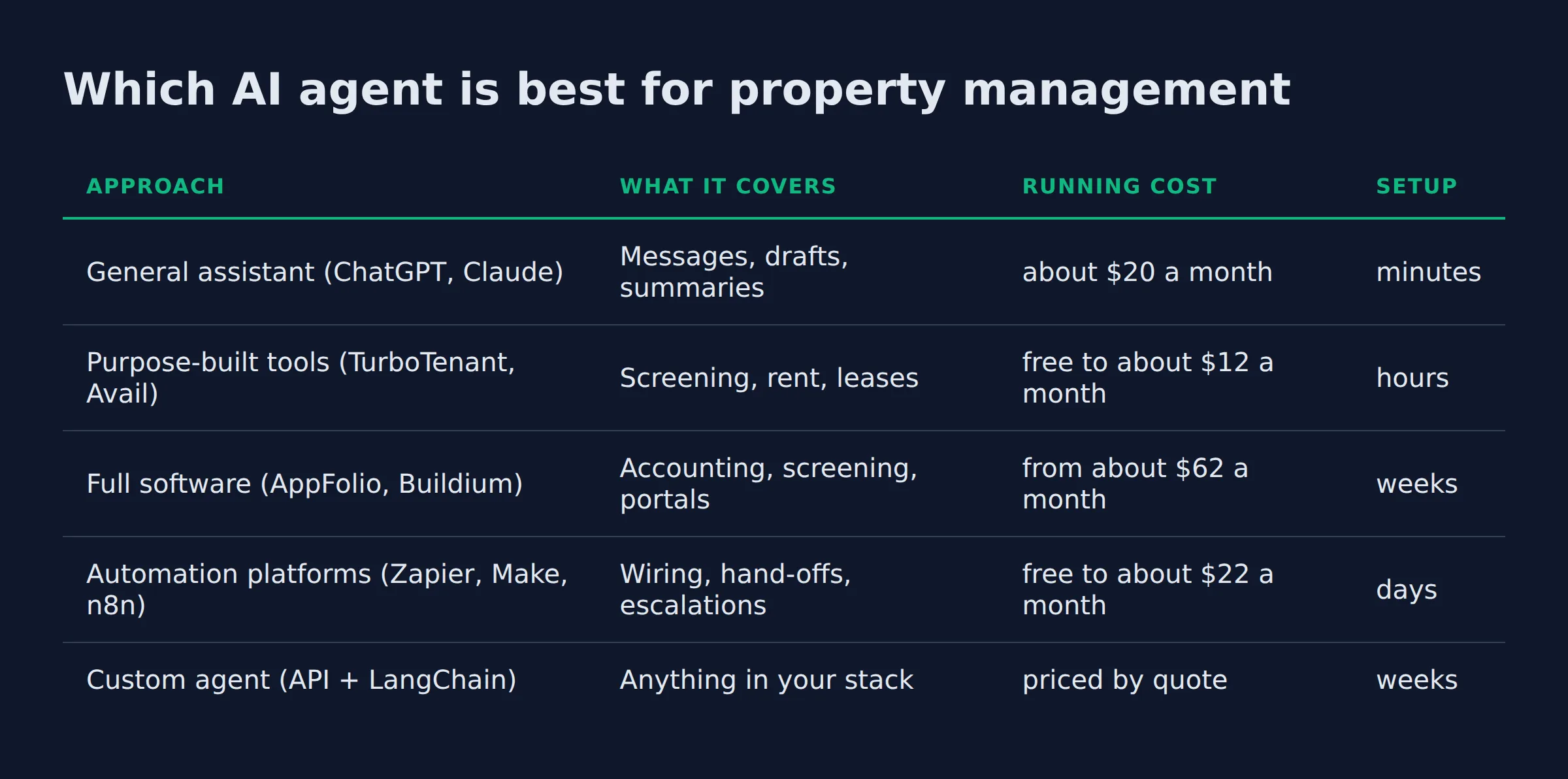
| Approach | What it covers | Running cost | Setup |
|---|---|---|---|
General assistant (ChatGPT, Claude) |
Messages, drafts, summaries | about $20 a month | minutes |
Purpose-built tools (TurboTenant, Avail) |
Screening, rent, leases | free to about $12 a month | hours |
Full software (AppFolio, Buildium) |
Accounting, screening, portals | from about $62 a month | weeks |
Automation platforms (Zapier, Make, n8n) |
Wiring, hand-offs, escalations | free to about $22 a month | days |
Custom agent (API + LangChain) |
Anything in your stack | priced by quote | weeks |
The answer shifts every few months because the models do. What holds steady is the fit.
Match the agent to the stack you already run. The fit matters more than the model name.
How much do AI agents cost for a property management company?
A general assistant like Claude Pro runs about $20 a month per seat. Purpose-built tools start free or at about $12 a month, and full software like Buildium starts at $62. Custom work prices by quote. The bill grows with what you automate.
Buildium screening reports run $17 to $35 each per Buildium. n8n’s Starter cloud plan costs 20 euros a month, about $22, billed annually on n8n’s pricing page. AppFolio publishes no number. It prices by quote against your portfolio on its pricing page.
| Setup | Monthly cost | Who it fits |
|---|---|---|
| Assistant only | about $20 | one person answering messages |
| Purpose-built tools | $0 to about $12 | small landlords, light volume |
| Full software plus screening | $62 and up | firms with many units |
| Managed or custom agent | priced by quote | anyone who wants it done for them |
For a managed or custom build, budget 3 lines: the software seats you already pay for, the build that connects the pieces, and monthly usage in messages, voice minutes, and model calls. I would not trust a fixed quote written before someone looked at your stack.
Check the claim before you pay. The FTC’s Operation AI Comply brought 5 actions against operations using AI hype or selling AI tools for deceptive ends (AI claims that cross the line). I test a tool on a real workflow before I pay for it.
You can run the first month under $50, and the spend should follow the hours it removes.
What the setup actually involves
Setup is mostly writing rules. The wiring is the easy part.
The connection comes first. Buildium ships an open API as part of its plans listed on its pricing page, and the connector usually exists before you start. The rules come second, and they take the real time:
- the tone and the working hours,
- the deposit math the agent never touches,
- the list of things it must hand off.
The connect check I run before go live:
- Which system owns the record, the CRM or the property software
- The fields you filter on, mapped one to one
- The duplicate rule, so one person is not created twice
- Rate limits on the API being called
- Where the hand-off lands, so replies arrive in a shared inbox
The third step is testing. Write 10 of the hardest messages you received last month and run them through the agent before launch. The ones it fails become your escalation rules. Run the same set again after any rule change.
Onboarding matters more than people expect. The front desk should know what to say when a tenant asks if they are talking to a robot. Say it plainly, and offer the human.
The free websites I build before prospects pay run on the same logic: prove the machine on one workflow, then let it grow. Start with messages and rent reminders. Add screening once it is boring.
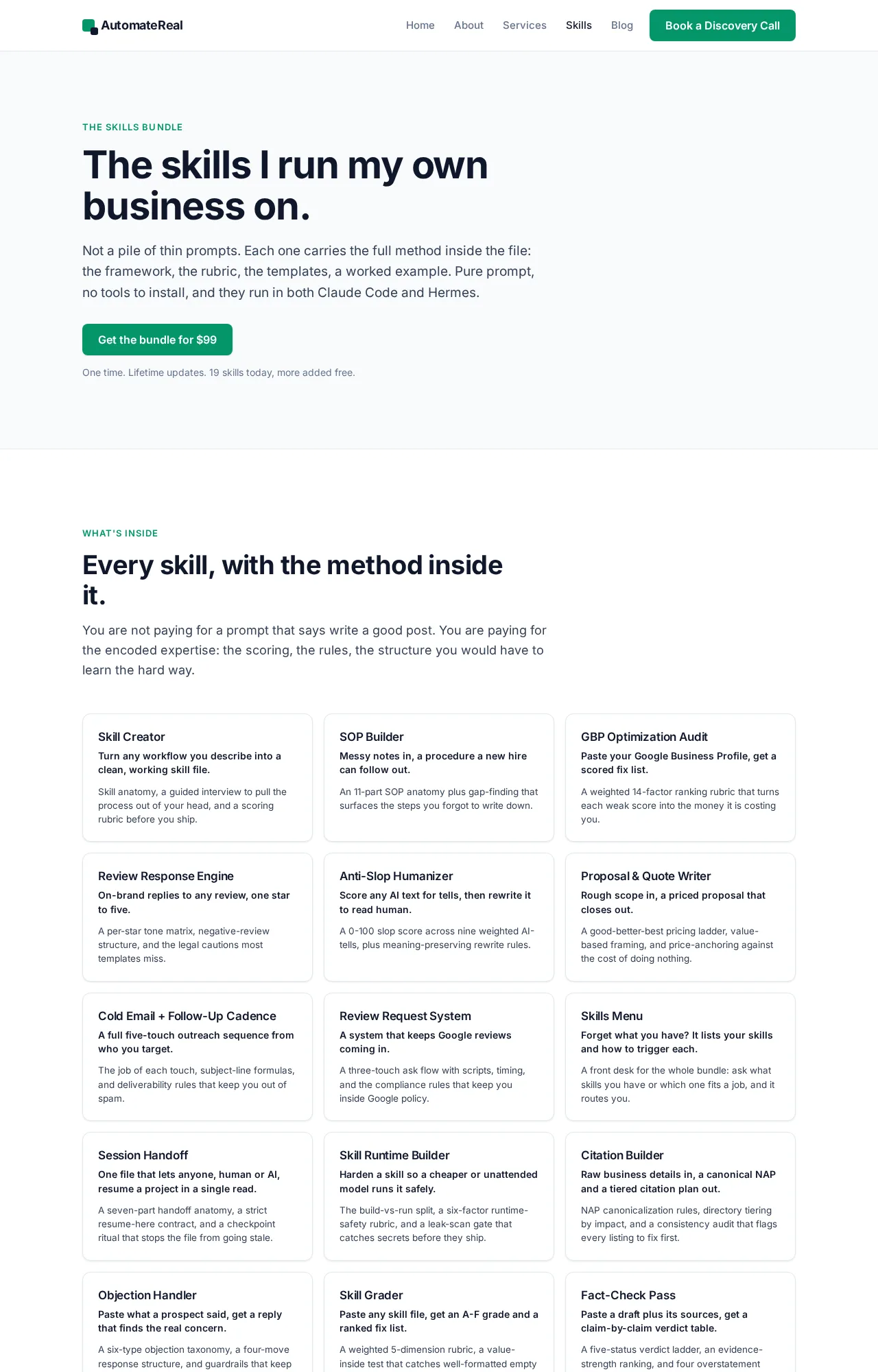
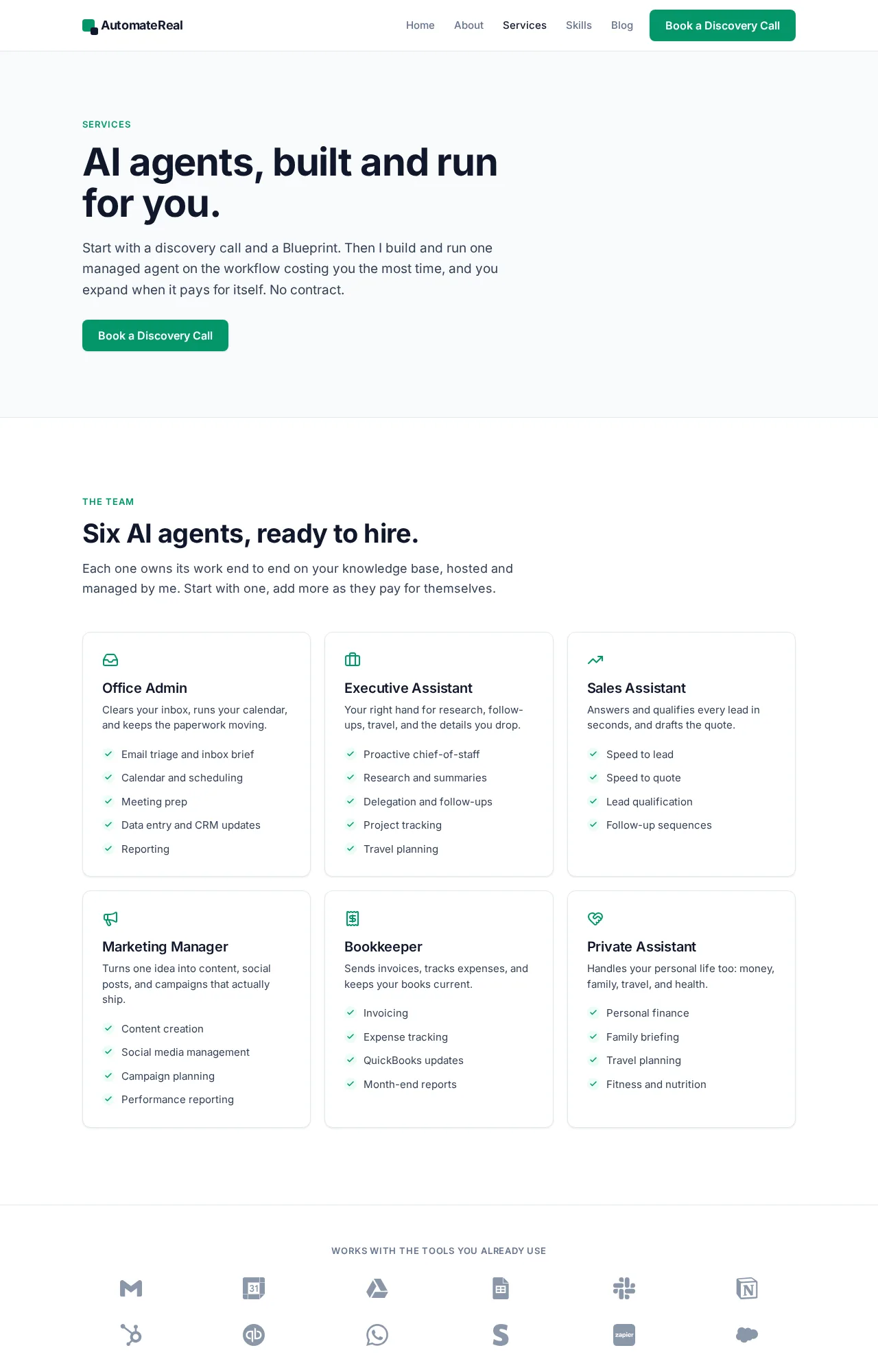
If you want the rules written for you, a managed agent covers that whole lane on the AI services page. The guardrail patterns I use every day are in the skills bundle, all skills for $99.
 AutomateReal skills
 AutomateReal services
Plan the setup around rules and testing. The wiring will be the easiest part of the week.
Can off-the-shelf AI agents cover property management, or is custom required?
Off-the-shelf agents cover the common core of property management, because the work repeats across companies. Inquiry replies, viewing bookings, resident questions, and work orders look the same in every portfolio. Custom matters only when your rules or your data layout are unusual, so start off the shelf and build where it hurts.
Custom work appears when your rules fit no template. A mixed-use building and an odd lease structure count, and so do compliance setups the default tools ignore. That is where a custom agent earns its keep, usually an API with a framework like LangChain on top of a current model.
This field is young, and honest sellers say so. Anyone selling a decade of agent experience is selling something. I can show you my own system.
Buy the common work off the shelf. Spend the custom budget only where your rules are unusual.
How do AI agents integrate with your existing property management software?
Most agents plug into the software you already run through an API connection. When the agent ships inside the platform, it uses the vendor’s own API. Automation platforms like Zapier or n8n do the wiring without code, and a web form covers the rare tool with no API.
Every message and rent record has to move between the agent and your property management software, your PMS. Nobody copies it over by hand. The pattern repeats across the major platforms, from AppFolio to Yardi. Listing data arrives over MLS and IDX feeds, and the RESO Data Dictionary sets the common field names.
Expect the field mapping to take the time. The fields in your software rarely line up with the fields in a new tool, and a duplicate record is the first thing to check after launch.
Test the connection on one real ticket before you trust the queue.
Related: How to Build an AI Agent
Related: Which AI Agent Should You Build First?
Related: What Is AI Automation? A Small Business Guide
FAQ
Will an AI agent replace my front desk or my property manager?
No. The agent removes repetitive volume, and people keep the judgment calls. The front desk handles the hard conversations, and the manager owns screening, rent policy, and legal steps. Roles stay, and weeks get lighter.
Are AI agents for property management safe with tenant data?
They can be, if the tool follows the law. Screening reports sit under the Fair Credit Reporting Act, so keep that data inside a compliant screening service. Check the provider’s data policy before you connect anything, and restrict who can see the conversations.
Can an AI property agent answer the phone, or is it chat only?
It can answer the phone. Voice agent platforms such as Retell and Vapi run the same pattern on a number you control. The transcript lands in the same record as the chat.
Do AI agents work for small landlords, or only large property management firms?
They work for both, and small teams get the bigger win. One landlord with one unit still answers messages and follows up on rent, and a single agent covers that work. A large firm adds software and screening on top.
What happens when the AI agent cannot answer a tenant’s question?
It escalates. The agent passes the conversation to a person with the full thread attached, so nobody repeats themselves. Money and legal questions go to a person, and anything that looks like discrimination does too.
Where to start with your first agent
Start with one workflow on one property. Count what changes for 2 weeks before you add the next job. If you want help finding that first workflow, a discovery call maps it in about thirty minutes. Book a discovery call.