AI Agents for Accounting Firms: What They Do & Cost
AI agents for accounting firms categorize transactions, reconcile accounts, close the month, and draft client emails. What they handle, what they cost, and what still needs a human.
AI agents for accounting firms are software systems that plan and run repetitive accounting work on their own. They pull bank feed and receipt data, categorize transactions, reconcile accounts, and close the month. They draft client emails and prepare report packages. They follow your firm’s procedures inside tools like QuickBooks Online, and they flag exceptions for a human to review before anything is sent.
You can describe the bookkeeping job in one sentence: take every bank line and every receipt and put it in the right box. An agent does that sentence for you.
Most writing on AI for accounting firms is theory, or a vendor selling its own tool. I run a local SEO agency and automate my own back office. Nobody sells a decade of agent experience, because nobody has one, including the people selling it.
TL;DR
- AI agents run the daily bookkeeping cycle: pull the bank feed, categorize, reconcile, flag the leftovers.
- They need 2 things from you: bank feed access and a chart of accounts you would defend.
- Firm plans run $35 to $250 per client per month. Solo plans start near $29 a month.
- Payroll, sales tax, and accruals stay with a person. The agent drafts the entry and a human signs it.
What are AI agents for accounting firms?
AI agents for accounting firms are large language models wired to the tools an accounting practice runs. Give one a job and it plans the steps, calls the tools, and finishes the task. A chatbot answers your questions. An automation follows the steps you wired by hand.
Four things get called AI inside an accounting stack, and they carry very different amounts of work.
| Layer | Who picks the next step | What it changes in your books | Your job |
|---|---|---|---|
| AI agent | The agent | Entries, document matches, the close checklist | Read the exceptions |
| Assistant or chatbot | You | Nothing until you move it yourself | Do the work |
Workflow automation (Zapier, Make, n8n) |
You, when you build it | One fixed path you defined | Keep the rules alive |
AI inside a suite (Intuit Assist) |
The vendor sets the scope | Suggestions inside one tool | Accept or reject |
Agentic AI is a system that reaches a specific goal with limited supervision, per IBM’s overview of agentic AI. An assistant waits for your prompt. An agent holds the goal and decides the next step. IBM also reports that 50% of companies already using generative AI planned agentic AI pilot programs in 2025.
Under the hood, an agent is a large language model reading your own ledger history. That is why the quality of your chart of accounts matters more than the model version.
The agent deciding its own next step is the whole difference. Everything else on this page follows from it.
How does an accounting AI agent work day to day?
The day starts with the bank feed. Before you wake up, the agent pulls new transactions and assigns categories from your history. It matches receipts and invoices to those lines, then queues what it cannot resolve. Your morning review takes minutes.
Booke AI’s product page describes that loop in plain terms: automate bank feed categorization, match documents, and review exceptions before reconciliation. The vendor also markets 80% faster transaction categorization, which is its own claim rather than an audited result, per its product page.
The exception queue is the part vendors show least. That queue holds the lines the agent could not decide, and it stays short in a business with clean rules. The same pattern that runs your transaction feeds can run your inbox and your report package, the way it runs customer questions in AI agents for customer support.
I see the same shape every day in my own business. My outreach system takes in around 200 form submissions a day and no one types them. Rows arrive, rules decide, and a person handles the leftovers. A bank feed is the same job with higher stakes.
Here is the test I would run before buying anything. Export your last 200 bank transactions. Count the lines with more than one plausible category. When that count passes my working threshold of about 1 in 10, fix the chart of accounts before you install an agent.
Read the exception queue before you read the feature list. The queue is the product.
Which accounting tasks can an AI agent handle, and which still need a human?
An agent handles categorization, reconciliation, document matching, and the close checklist. A person keeps payroll, sales tax, accruals, and owner draws. The agent drafts the entry, and a human signs the number that goes to a bank or the IRS.
| Task | Runs without you | Where a person stays |
|---|---|---|
| Transaction categorization | Usually | New vendors and split lines |
| Bank reconciliation | Usually | Unmatched items and timing gaps |
| Receipt and invoice matching | Usually | Missing or unreadable documents |
| Month-end close checklist | Partly | Journal entries and adjustments |
| Client follow-up emails | Drafted | Anything with advice in it |
| Payroll | No | Deposits, filings, and pay changes |
| Sales tax | No | Rates across states and product rules |
| Financial statements | Drafted | Review by the CPA |
The basis you run changes the job. On cash basis, most entries come straight off the bank feed. On accrual, somebody has to decide what belongs in the period.
Every entry has to stand behind a document, and how long you keep that document depends on what it proves, per the IRS recordkeeping rules. The agent should leave an audit trail that shows what it changed and when.
The exceptions that land back on a person cluster in 5 places.
- Split transactions, where one payment covers 2 jobs.
- Owner draws and personal spend on a business card.
- Duplicate vendors under slightly different names.
- Accruals the agent cannot see from the bank feed.
- Sales tax edges, like a new state or a new product line.
Categorization and reconciliation are agent work. Payroll, sales tax, and accruals stay with the bookkeeper or CPA.
Which accounting AI agents are worth looking at?
The names worth a look fall into 3 groups. Full-service platforms carry a human team behind the agent. Self-serve tools bolt onto QuickBooks Online. Firm-grade agents close the month for an accounting team.
| Tool | Where it plugs in | The job it covers |
|---|---|---|
| Zeni | Its own platform, plus an MCP connector to Claude and Codex | Bookkeeping, payroll, and a team behind it |
| Digits | 12,000+ banks and payroll providers, plus an API and MCP | Agentic close for accounting firms |
| Bookeeping.ai (Paula) | QuickBooks import, Stripe, and bank connections | Cash-basis books for a sole owner |
| Booke AI | The QuickBooks Online bank feed |
Categorization and reconciliation inside QBO |
| Pilot | Its own platform and QuickBooks | Full-service bookkeeping with tax add-ons |
| Docyt | Bank feeds, QuickBooks Online, and 30+ POS systems | Multi-entity books and variance flags |
MCP connectors are the newest row in this market. The name is short for Model Context Protocol, and a connector lets an assistant read the ledger. Digits hands you a free API and MCP so ChatGPT, Claude, or Cursor can query the books.
The AIMultiple roundup covers 15 accounting AI agents and names Vic.ai for high-volume accounts payable and Docyt for multi-entity books, per that roundup.
Treat every marketing number as a claim. Bookeeping.ai advertises 96% of bookkeeping automated and 76 hours saved a month, per its homepage. Pilot announced a fully autonomous AI Accountant in February 2026, and BILL reports the share of transactions it processed fully with AI rose 533% in early rollout at about 92% accuracy, per the same roundup.
Expect the first 2 weeks to be a training period for the rules. Count the corrections you make in that window, because that count is your real setup cost.
Read the vendor’s own pricing page before you read any roundup. Prices in list posts go stale fastest.
What do AI agents for accounting firms cost?
Firm plans run $35 to $250 per client per month, and small solo plans start near $29 a month. Setup and catch-up bookkeeping sit on top of the list price. Your own review time is the one cost that never shows on a pricing page.
| Plan | Published price | What drives the bill |
|---|---|---|
| Digits firm plans | $35 to $250 per client per month (Essentials $65, Core $100) | How many clients you close |
| Pilot Bookkeeping | Essentials $99 a month up to $100,000 in monthly expenses. Core from $299 a month billed annually | Entity type and tax packages |
| Bookeeping.ai (Paula) | From $29 a month | One owner, cash basis |
The unit matters. Digits prices per client, not per seat. Pilot’s tax packages must be bought with its bookkeeping and run from $750 a year for a just-formed company to $2,450+ for a C-Corp, per its pricing page.
Beyond the license, 3 lines move the bill.
- The integration work: connecting bank feeds, OCR, and your accounting software.
- The catch-up cost when the books are months behind.
- The upkeep: checking exceptions and updating rules when a procedure changes.
The rule I use on my own stack is one week on live data. Week two is where the exceptions show up, and that is the week I judge a tool on.
Per-client pricing and exception volume decide your real cost. Both numbers sit off the pricing page.
How do AI agents fit into the tools an accounting firm already uses?
Through APIs and connectors. Agents read and write through QuickBooks Online, Xero, Zoho Books, or Sage. Read-only access answers questions, and write access closes the month.
The stack breaks into 6 parts.
- The ledger:
QuickBooks Online,Xero,Zoho Books, orSage. - The bank feed: the agent reads transactions as they post.
- Documents: receipt and invoice OCR through tools like
DextorHubdoc. - Bill pay: accounts payable and invoicing sit in
BILLand similar tools. - The automation layer: a general tool such as
Zapier,Make, orn8nhandles the flows around the ledger. Use it to chase a receipt or post a payroll summary. - Assistants:
Intuit Assistinside QuickBooks, and MCP connectors for Claude, ChatGPT, or Codex.
The write list decides the value. Ask for the objects the agent can create or update, and ask for that list in writing. Reading a bank feed and posting a journal entry are different permissions.
Suites ship their own assistants too. Intuit’s own review of AI accounting tools covers 12 products for 2026, and the suite you already run is probably on that list. Check what you own before you add a subscription.
Ask for the write list in writing. Reading the ledger and posting to it are different permissions.
Are AI agents for accounting firms safe and compliant?
Yes, when the firm keeps a human in the review loop and the vendor holds the right credentials. The agent does the work up to a limit, and anything unusual or client-facing stops for a person. Compliance is a firm procedure, and the agent enforces the procedure you set.
AICPA guidance and the professional standards of CPA practice govern what an AI system may do with client data, and they require the accountant’s professional judgment on top of any machine output. Ask for the vendor’s SOC 2 report rather than trusting a badge on a sales page.
Insurance agencies face the same review and credentials question with policyholder data, covered in AI agents for insurance agencies.
When an agent follows an accountant’s procedures, tax season changes shape. A 2025 CPA.com report cited by the Journal of Accountancy notes some firms have automated more than 80% of individual tax return preparation with AI-assisted tools. The number is a firm claim, not a promise, and it still runs inside human review.
Keep one review step in every month so an error cannot compound quietly.
Is an off-the-shelf agent enough, or does a firm need a custom one?
Off the shelf fits a client on 1 set of books with a standard chart of accounts. A custom agent earns its keep when the rules are unusual or the books span several entities. Start off the shelf, then measure what still fails.
A custom agent buys 3 things.
- Your own rules for the categories only your clients use.
- Your own exception definitions, so the queue holds real problems.
- A queue that lands inside the tool your team already opens.
The decision rule is boring and it works. Run the off-the-shelf agent for 30 days and count the corrections you still make by hand. A falling count means you are done. A flat count means that recurring correction is your custom scope.
I have not run these agents inside someone else’s firm yet, and I say that in writing. What I have run is my own operation, where lead intake and follow-up work without me touching them. The first workflow most small teams hand over is covered in AI agents for small business.
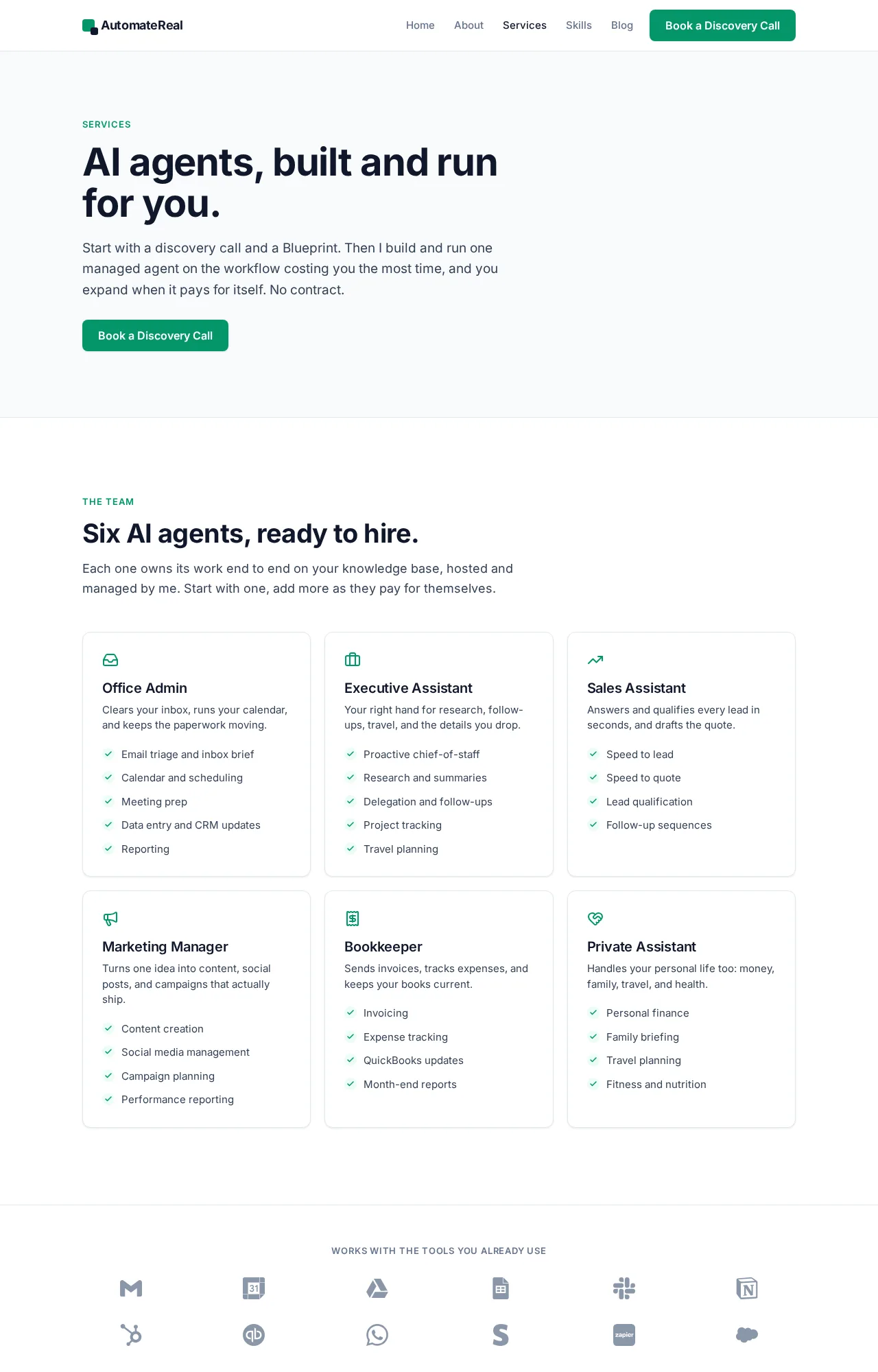
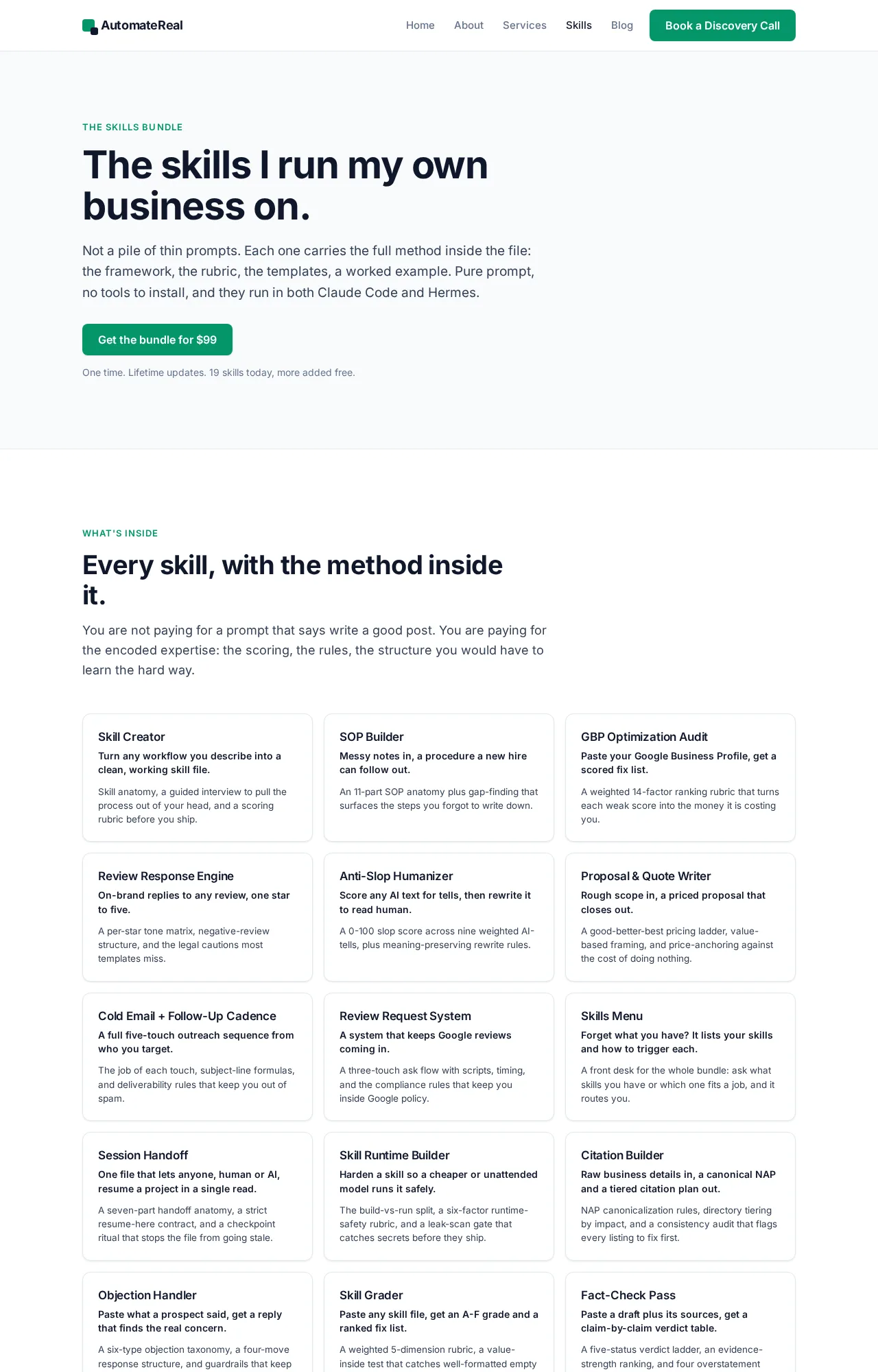
If you want the setup done for you, the AI services page covers what a done-for-you build includes. I also sell all of my skills as a bundle for $99 at the skills page, which is the do-it-yourself end of the same problem.
 AutomateReal services
 AutomateReal skills
30 days on the off-the-shelf agent tells you the custom scope. Buy custom work for the correction that keeps coming back.
Related: claude skills vs mcp vs agents
Related: what is automation
Related: How to Build an AI Agent
FAQ
Do AI agents replace accounting staff?
No. They shift the work and keep the roles. Your bookkeeper stops typing entries and starts reviewing exceptions. Your accountant still sets the policy and signs the statements. The firm loses the data entry and keeps the judgment.
What is the difference between an AI agent and a chatbot for accounting?
A chatbot answers from a script. An agent plans, calls tools, and completes a task. Ask a chatbot to categorize a bank feed and it talks about it. An agent reads the feed, applies your rules, and updates the ledger.
Can AI agents handle tax season work?
Yes, on the repeat parts. AI-assisted tools have automated a large share of individual tax return preparation in some firms, per a 2025 CPA.com report cited by the Journal of Accountancy. A person signs the return, so the filing stays with the CPA.
Is it safe to give an AI agent a bank feed and the books?
The bank connection is read-only until you grant write access, and the agent inherits whatever you approve. Ask for the SOC 2 report, the data security page, and the retention window for documents and ledger history.
What does an accounting AI agent need before it can start?
Bank feed access, a chart of accounts you would defend, and your category rules written down. Add the receipt and invoice folder next, since those documents are what make an entry stand up later.
If you want help finding that first accounting workflow, a free discovery call maps it in about thirty minutes.